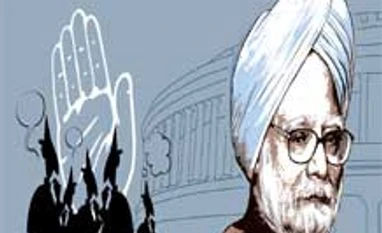
UPA II working under coalition pressure: Panelists
Adi Godrej says threat from some of the coalition partners kept UPA-II from taking strong political decisions
Somesh Jha New Delhi Amid various macro economic parameters slowing down, the UPA government today drew flak from panelists for its lack of decision making in a coalition politics in its second stint.
"The political leadership at the top is more concerned about keeping the coalition alive than taking concrete steps", said leading industrialist and former CII president Adi Godrej. He was speaking at a CII's panel discussion on 'How Indian Companies Leveraged Reforms' here.
He said threat from some of the coalition partners kept UPA-II from taking strong political decisions. "A strong leader knows his coalition threat, takes strong decision and still continues to be in power", he said.
Godrej observed that a political consensus has been very fragile in the last few years in the country.
India's economic growth slowed down to a decade low of 5 per cent in 2012-13 and a four-year bottom of 4.4 per cent in the first quarter of the current financial year.
Larger economic parameters are yet to show signs of improvement, except for exports and current account deficit. The government has been charged by rivals with policy paralysis, even as the ruling coalition has been maintaining that it has been addressing the issues of slow growth.
Rajya Sabha member N K Singh, who was Secretary to the Prime Minister during the NDA rule, said that the country needs two reforms -- stringent labour laws in the manufacturing sector and management of various institutions with good leadership qualities.
"We need a system that can enable India garner the benefits of comparative factor advantage through elastic supply of skill and semi skilled labour", Singh said.
He added that various regulatory bodies are not enough to usher in reforms but we need "leadership reforms" to cater to them.
Singh said that a strong bipartisan system is crucial for the country. "Taking difficult measures would not be popular but politicians surely need to step in", he said.
On a day when differences between the Centre and states resurfaced over constutional amendment Bill on GST, Godrej said that introduction of this legislation is one of the most important reform that the country needs.
"It is an extremely important reform which will help to improve manufacturing, exports and logistics", said Godrej, He said that this could add as much as two percentage points to the Gross Domestic Product growth.
Godrej pointed point that India has always been poor in terms of ease of doing business. "Even after 1991, we are ranked very poorely in this regard. Last few years, we have deteriorated even further. We must have a clear plan to come up in global ranking", he said.

 "UPA II working under coalition pressure: Panelists")


 Connect with us on WhatsApp