Yogi Adityanath, the Uttar Pradesh chief minister (CM), is expected to shuffle his ministerial council possibly for the last time before the state goes to polls early 2022. While the prospective rejig sparked off the who’s-in-who’s-out speculation in Lucknow, one person evoked inordinate interest, despite not being a hard-core politician. That was AK Sharma, a former bureaucrat who voluntarily retired as the union government’s secretary, micro, small and medium enterprises, in January this year and opted for politics. An officer who had Prime Minister (PM) Narendra Modi’s ears since Modi’s years in Gandhinagar as the Gujarat chief minister, Sharma was elected to the UP Legislative Council shortly after quitting the civil service. The whispers in the power corridor said Sharma, who belongs to Azamgarh, was set to be inducted in Adityanath’s cabinet as a senior minister. The reason? Not one but many. Apart from enjoying the PM’s trust and confidence — Sharma also served as an additional secretary in the PM’s Office — for long the Bharatiya Janata Party (BJP) chafed at Adityanath’s tendency to ignore its leaders, legislators, and office-bearers by making himself allegedly “inaccessible” and expecting them to work through his cherry-picked bureaucrats.
Apart from enjoying the PM’s trust and confidence, Sharma also served as an additional secretary in the PM’s Office
As subterranean tensions crept in between Adityanath and the state BJP by the day — manifesting in the form of a letter shot off to the CM by Union Minister Santosh Gangwar, statements by UP ministers, and video recordings of the travails undergone by legislators — the Centre stepped in. A series of meetings were held in Delhi and Lucknow over the past few days. It kicked off on May 23 when BJP President JP Nadda convened a meeting at which Prime Minister Modi, Home Minister Amit Shah and Dattatreya Hosabale, the general secretary of the Rashtriya Swayamsevak Sangh (RSS), were present. The leaders, who were briefed exhaustively on the ground situation and the anger in the BJP’s rank-and-file with the state government, took a measure of things and despatched BL Santhosh, the BJP general secretary (organisation) and Radha Mohan Singh, the national vice-president minding UP, to Lucknow for a closer assessment.
An added worry was the BJP’s below-par showing in the panchayat polls which Adityanath refused to put off although the elections claimed the lives of several poll agents. Although the elections were not fought on party symbols, the BJP pledged its official support to 3,050 ward members. A ballpark estimate was only 900 of those won.
On May 31 and June 1, Santhosh and Singh met the BJP’s officials, the “pracharaks” designated to oversee the various regions, ministers and legislators as well as the CM. In the end, they scotched rumours of a leadership change, commended Adityanath for his “unparalleled” pandemic management, hard work, and clean image. However, they took care to hyphenate their praise for Adityanath with Modi.
The issue of whether Adityanath will dominate the BJP’s electioneering as the “star” remains “unresolved”, claimed BJP insiders. A UP BJP source explained, “In Uttarakhand, we changed the CM smoothly because both the Rawats (Trivendra Singh, the former CM, and Tirath Singh, his successor) are our men and unlikely to breach disciplinary norms. Adityanath has enormous damage potential because his Hindu Vahini (the outfit he floated as a private militia in Gorakhpur) is active. In the 2012 (Assembly) polls, when his nominees didn’t get tickets, he fielded them as Independents and ensured we lost all the seats in the Gorakhpur region. The larger points in Adityanath’s favour are his aura as a Hindutva icon and an image that he’s incorruptible because he is single. Also, after the recent flak, he toured the districts without a break.”
Brijesh Shukla, a veteran Lucknow-based political observer, said people’s anger towards the CM will not dissipate in a hurry despite the attempted damage control. “People are angry with Yogi, especially for going ahead with the panchayat polls despite warnings from BJP workers. Modi should lead the elections because he is more popular in the rural areas,” said Shukla. Academic Badri Narayan, who teaches in Allahabad’s Govind Ballabh Pant Social Sciences Institute, thought the BJP had no option but to go with Adityanath. “Even at a time when the state has withered away, he is trying to tell people I am working. Without doing anything, he gives an impression he is doing a lot,” said Narayan.

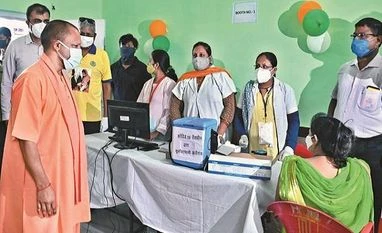 "Why is BJP wary of projecting Adityanath as a 'star' in UP Assembly polls?")











