Home / India News / Why UP is vital for BJP to win presidential polls
Why UP is vital for BJP to win presidential polls
Its current majority of 22,078 votes for the purpose of the presidential elections is considered thin, particularly when BJP might not be able to predict voting behaviour of its allies like Shiv Sena
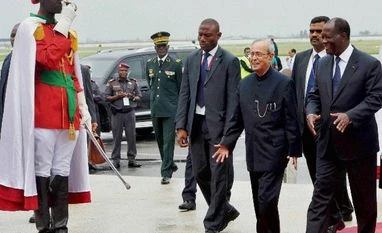
President Pranab Mukherjee with his Ivory Coast President Alassane Ouattara inspects the Guard of Honour during ceremonial welcome at Abidjan International Airport in Republic of Cote D’ivoire, Abidjan
The Bharatiya Janata Party (BJP) foresees a close contest to elect the successor to President Pranab Mukherjee at Rashtrapati Bhavan. It is, therefore, keen to improve its tally of seats in the Assembly polls to five states, including the key state of Uttar Pradesh, that are scheduled to be held by February-March 2017. The Presidential polls are slated for July 2017.
According to the BJP’s calculations, the National Democratic Alliance (NDA) currently has a majority of 22,078 votes for the presidential elections. The numbers in its favour have increased after its resounding two-third majority victory in Assam, winning three seats in West Bengal and one in Kerala in the recently concluded polls.
A senior party leader on Wednesday expressed the confidence that the NDA, which comprises over half a dozen parties with a presence in Parliament, can win the elections on its own. However, a majority of 22,078 for the purposes of the presidential elections is considered thin, particularly when the BJP might not be able to predict the voting behaviour of its allies like Shiv Sena and Telugu Desam Party.
Election of the President of India is indirect. The President is elected by an electoral college comprising all members of Parliament, minus its nominated members, and the members of all legislative Assemblies, including of the two quasi-states, Delhi and Puducherry.
The value of each of the 4,120 MLAs and 776 MPs (both Lok Sabha and Rajya Sabha) is calculated by a formula. The total value of all these votes is 1,098,882, which makes quite miniscule a majority of 22,078.
This is one reason why the BJP has been striving hard to improve its numbers in all state Assembly polls as well as in the Rajya Sabha.
For the presidential polls, the value of each vote of an MLA is calculated on the basis of a formula that divides the population of that state with the number of seats in the Assembly of that particular state and further divided by a thousand. For ascertaining the population of a state, the 1971 Census is taken as the benchmark.
Among the states, value of the vote of an Uttar Pradesh MLA is the highest because of its population, and consequently the biggest assembly with 403 seats. The value of the vote of each UP MLA is 208. The total value of the votes of all 4,120 MLAs is 549,474.
As for Parliament, nominated members of the two Houses cannot vote in the presidential elections. The value of an MP’s vote is calculated by dividing the total value of the votes of MLAs by the number of 776 MPs (Lok Sabha’s 543 and Rajya Sabha’s 233). Each MP’s vote has a value of 708. The total value of MP votes is 549,408.
The BJP as well as NDA is in a minority in the Rajya Sabha. The BJP, along with its allies like Peoples Democratic Party and Shiromani Akali Dal, have governments in 12 states. It faces two term anti-incumbency in both Punjab and Goa. Its allies have governments in Andhra Pradesh and Nagaland. However, it doesn’t have governments in some of the states with large assemblies like West Bengal, Uttar Pradesh, Bihar and Tamil Nadu.
Currently, BJP has barely 50-odd MLAs in UP assembly. It wants to win UP, but even in the worst case scenario it would want to improve its current tally in that Assembly.

 "Why UP is vital for BJP to win presidential polls")

