
Delhi air quality remains poor for 3rd day, stubble burning may worsen it
Delhi's AQI is predicted to deteriorate to 256 on Sunday
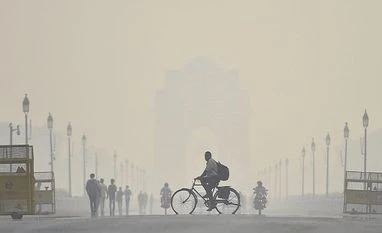 "Delhi air quality remains poor for 3rd day, stubble burning may worsen it")
WebinarsNew
Deep DiveNew
Explore Business Standard
Delhi's AQI is predicted to deteriorate to 256 on Sunday
The national capital's air quality remained "poor" for the third day on the trot on Saturday and is likely to deteriorate further, even as experts said the situation is better than that in the last few years.
The Centre-run System of Air Quality and Weather Forecasting And Research (SAFAR) recorded the overall air quality index (AQI) at 221, which falls in the "poor" category.
The city's AQI is predicted to deteriorate to 256 on Sunday.
SAFAR said stubble burning in neighbouring states contributed 2 per cent to the total concentration of PM2.5, particulate matter 2.5 micrometers or less in diameter, in Delhi on Saturday and it will increase to 6 per cent by October 15.
Pollution levels will move towards "very poor" by the third week of October, it said.
A senior official said the air quality is not likely to deteriorate drastically for the next two to three days as the wind speed is not enough to transport smoke from the burning of stubble in Haryana and Punjab to Delhi.
While Haryana has recorded 481 cases of crop residue burning till October 11 against 547 in the corresponding period last year -- a decrease of 12 per cent, Punjab has reported an increase of 195 cases -- from 435 in 2018 to 630 in 2019.
SAFAR said the AQI is still much better than the last few years in this time of the year, partly due to enough widespread moisture with relatively warmer temperatures around the surrounding areas of Delhi.
"Delhi's air quality was recorded in the 'satisfactory' category till October 2 and in the 'moderate' category till October 9. It turned poor for the first time in the season on Thursday.
"Last year, the city's air quality had turned very poor on October 7," the official said.
SAFAR said the increased biomass fire counts in Haryana and Panjab are likely to influence Delhi's AQI now.
"The surface wind speed continues to be slow and variable with predominant direction from the West. Under these conditions, air quality is predicted to deteriorate to the middle of the poor category by Sunday. Further deterioration of the AQI is expected by October 14," it said.
Starting October 15, stricter measures to fight air pollution will come into force in Delhi and its neighbourhood as part of the Graded Response Action Plan (GRAP), which was first implemented in Delhi-NCR in 2017.
First Published: Oct 12 2019 | 9:00 PM IST

