Home / Economy / News / IMF against competitive devaluation, protectionism
IMF against competitive devaluation, protectionism
IMF said global growth has been subdued for a long time and outlook has weakened somewhat since October
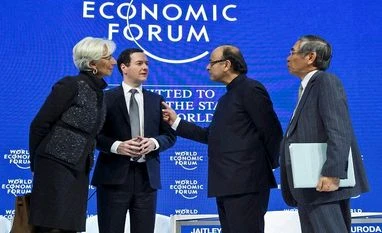
IMF chief Christine Lagarde, left, Britain's Chancellor of the Exchequer George Osborne, 2nd left, Indian Finance Minister Arun Jaitley, 2nd right, and Governor of the Bank of Japan Haruhiko Kuroda, talk at the WEF in Davos, Switzerland
The IMF has asked member countries to refrain from competitive devaluations and all forms of protectionism as it underlined the need for global cooperation in combating corruption, reinvigorating global trade integration and addressing international tax issues.
In a communique issued Saturday during the annual Spring meeting of the International Monetary Fund (IMF) and the World Bank, the IMF asked its member countries "to refrain from all forms of protectionism and competitive devaluations and to allow exchange rates to respond to changing fundamentals".
The IMF said global cooperation is needed on several fronts. These included ensuring a well-functioning international monetary system, reinvigorating global trade integration and combating corruption and improving governance.
Global cooperation is also needed on addressing international tax issues including transparency, coping with challenges of non-economic origin, including those pertaining to refugees, the IMF said.
It also sought global cooperation for consistently implementing and completing the financial regulatory reform agenda, including policies to transform the shadow banking sector into a stable source of market-based finance.
Observing that the global economy continues to expand modestly, the IMF said global growth, however, has been subdued for a long time and the outlook has weakened somewhat since October.
Although recent developments point to some improvements in sentiment, financial market volatility and risk aversion have risen, reflecting partly the reappraisal of potential growth, the communique said.
"The significant slowdown in global trade growth also persists. Recoveries in many advanced economies are restrained by a combination of weak demand, low productivity growth and remaining crisis legacies," the IMF said.
"Activity in emerging market and developing economies has cooled down, although it still accounts for the bulk of world growth. Globally, lower commodity prices have adversely affected exporters, while their short-term growth impact on energy importers has been less positive than expected," the IMF said.
Downside risks to the global economic outlook have increased since October, raising the possibility of a more generalised slowdown and a sudden pull-back of capital flows, it said.
At the same time, geopolitical tensions, refugee crises and the shock of a potential UK exit from the European Union pose spillover risks, it added.
Reinforcing its commitment to strong, sustainable, inclusive, job-rich and more balanced global growth, the IMF said to achieve this it will employ a more forceful and balanced policy mix.
"Implementation of mutually-reinforcing structural reforms and macroeconomic policies, using all policy tools, individually and collectively is vital to stimulate actual and potential growth, enhance financial stability and avert deflation risks," the IMF said.

 "IMF against competitive devaluation, protectionism")


 Connect with us on WhatsApp