India cannot rise by containing China or picking one side against the other, an op-ed article in a Chinese state-run paper Global Times said on Wednesday, taking note of the Indo-US ties.
"Four visits to the US and seven meetings with President Barack Obama in two years - Indian Prime Minister Narendra Modi has ramped up the India-US relationship to an unprecedented level. How the two countries will engage with each other has raised heated discussions," an op-ed said.
It added, "Picking one side or camp against the other is not the way India will rise. New Delhi is looking into a multi-faceted diplomacy. The well performing Indian economy will give incentives to the country to be more confident with multilateralism and to seek balanced international relations."
"Although rivalling China in many aspects, India knows its great vision cannot be realised by bashing or containing China. Instead, they should expand cooperation, explore the potentials and build mutual trust for their own good. China is more of a help than a competitor for India. This will eventually constitute India's fundamental understanding of China," it said referring to Modi's current visit to the US.
With Modi's visit, New Delhi hopes there will be breakthroughs in many aspects, especially business and trade, security cooperation and nuclear issues, the article titled 'India's vision cannot be realised by containing China' said.
"The transformation of the geopolitical landscape is the major driver drawing the US and India much closer. Washington's rebalance to the Asia-Pacific makes the US realise India's strategic significance, economic potential and ideological commonality," the article noted.
"India hopes that by consolidating its relationship with the US, it could gain leverage in development and forge an international status that is worthy of its potential. Modi has riveted his interactions with the US on this simple outlook to make India a veritable powerhouse. He was eager to boost a broader and better economic relationship with the US," it asserted.
"He urged the signing of the Logistics Exchange Memorandum of Agreement, a landmark deal promoting logistics and defence cooperation with the US and he also expects an endorsement from the US to help India become a member of the Nuclear Suppliers Group, the last step to solidify India's status as a nuclear power house," the article said.
As for Washington, it is always hoping that India could serve as its right hand to counterbalance China's rise. But so far, Washington's calculations do not work well. Turning down Washington's invitation to join a patrol in the South China Sea, New Delhi has no intention to cast away its founding principles: independence and non-alignment, it said.
"In the process of fulfilling its ambition to be a major power, India has always employed independent and pragmatic approaches. A balance between other major powers will be its primary and optimal choice," the article added.

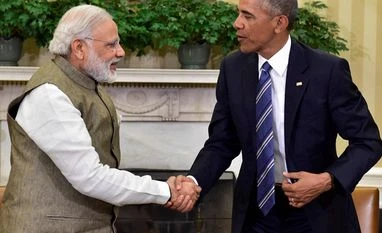 "India's vision can't be realised by bashing China: state media")


 Connect with us on WhatsApp