
Kashmir is issue between India-Pak; US ready to assist talks: State Dept
It also said Pakistan taking "sustained and irreversible" steps against terrorism is key to a successful dialogue with India
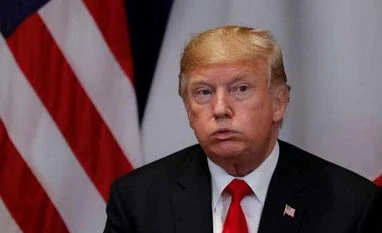 "Kashmir is issue between India-Pak; US ready to assist talks: State Dept")
WebinarsNew
Deep DiveNew
Explore Business Standard
It also said Pakistan taking "sustained and irreversible" steps against terrorism is key to a successful dialogue with India
The Trump administration has launched a damage control exercise after the President's remarks about mediation on Kashmir, with the State Department on Tuesday saying it was a "bilateral" issue between India and Pakistan, and the US "welcomes" the two countries "sitting down" for talks.
It also said Pakistan taking "sustained and irreversible" steps against terrorism is key to a successful dialogue with India.
"While Kashmir is a bilateral issue for both parties to discuss, the Trump administration welcomes Pakistan and India sitting down and the United States stands ready to assist," a State Department spokesperson told PTI in response to a question if Trump's remarks reflect a change in the country's policy on Kashmir.
India has already rejected Trump's claim that Prime Minister Narendra Modi sought his mediation on the Kashmir issue.
For more than a decade, the US has consistently insisted that Kashmir is a bilateral issue between India and Pakistan and it is for the two countries to decide on the nature and scope of the dialogue.
"We believe the foundation for any successful dialogue between India and Pakistan is based on Pakistan taking sustained and irreversible steps against militants and terrorists on its territory. These actions are in line with Prime Minister (Imran) Khan's stated commitments, and Pakistan's international obligations," the State Department spokesperson said.
"We will continue to support efforts that reduce tensions and create an environment conducive for dialogue. This first and foremost means tackling the menace of terrorism. As the President indicated, we stand ready to assist," the spokesperson said in response to a question.
On Monday, Trump stunned India by saying that Prime Minister Modi, during the G20 summit in Osaka, Japan, sought his help in resolving the Kashmir issue.
"I was with Prime Minister Modi two weeks ago and we talked about this subject (Kashmir). And he actually said, 'would you like to be a mediator or arbitrator?' I said, 'where?' (Modi said) 'Kashmir'," Trump said during his talks with Khan, their first since the latter came to power in August, 2018.
"Because this has been going on for many, many years. I am surprised that how long. It has been going on (for long)," he said, with Khan responding 70 years.
"I think they (Indians) would like to see it resolved. I think you would like to see it resolved. And if I can help, I would love to be a mediator. It should be....we have two incredible countries that are very, very smart with very smart leadership, (and they) can't solve a problem like that. But if you would want me to mediate or arbitrate, I would be willing to do that," Trump said.
"So all those issues should be resolved. So, he (Modi) has to ask me the same thing. So maybe we'll speak to him. Or I'll speak to him and we'll see if we can do something," Trump said.
Khan welcomed these remarks. "President, I can tell you that, right now, you would have the prayers of over a billion people if you can mediate and resolve this issue," he said.
In New Delhi, The Ministry of External Affairs was quick to deny that Modi ever asked for a mediation on Kashmir.
"We have seen President Trump's remarks to the press that he is ready to mediate, if requested by India and Pakistan, on the Kashmir issue. No such request has been made by Prime Minister to the US President," MEA spokesperson Raveesh Kumar said.
"It has been India's consistent position that all outstanding issues with Pakistan are discussed only bilaterally. Any engagement with Pakistan would require an end to cross border terrorism. The Simla Agreement and the Lahore Declaration provide the basis to resolve all issues between India and Pakistan bilaterally," Kumar said.
In the past two and half years, the Trump Administration has gone a step ahead, as compared to his predecessors', in supporting India's fight against terrorism. In the immediate aftermath of the Pulwama terrorist attack, the White House supported India's right to self defense.
And in the middle of the election season in India in May, the Trump Administration went out of its way to ensure that 26/11 mastermind Masood Azhar is designated by the United Nations Security Council. The US exerted pressure on China which for about a decade vetoed any such move.
First Published: Jul 23 2019 | 7:40 AM IST


 Connect with us on WhatsApp