North Korea on Monday celebrated the launch of what appeared to be its longest-range ballistic missile yet tested in a bid to bring the US mainland within reach, saying it was capable of carrying a "heavy nuclear warhead".
Leader Kim Jong-Un personally oversaw the test on Sunday, the official Korea Central News Agency (KCNA) said, and pictures by state media showed him gazing at the missile in a hangar before the launch.
In other words, he gleefully clasped hands with officers and staff after the black missile — named as the Hwasong-12 — ascended into the sky in the dawn light, atop a column of fire.
The isolated North is under multiple sets of United Nations sanctions over its nuclear and missile programmes, which have triggered global alarm.
The missile was launched on an unusually high trajectory, with KCNA saying it flew to an altitude of 2,111.5 kilometres and travelled 787 kilometres before coming down in the Sea of Japan (East Sea).
That suggests a range of 4,500 kilometres (2,800 miles) or more if flown for maximum distance, analysts said.
Aside from Pyongyang's space launches, Jeffrey Lewis of the Middlebury Institute of International Studies in the US told AFP: "This is the longest-range missile North Korea has ever tested."
On the respected 38 North website, aerospace engineering specialist John Schilling said it appeared to demonstrate an intermediate-range ballistic missile that could "reliably strike the US base at Guam" in the Pacific.
"More importantly," he added, it "may represent a substantial advance to developing an intercontinental ballistic missile (ICBM)".
The North has carried out two atomic tests and dozens of missile launches since the beginning of last year in its quest to develop a missile capable of delivering a nuclear warhead to the continental United States — something President Donald Trump has vowed "won't happen".
KCNA said the new rocket was a "perfect weapon" which was "capable of carrying a large-size heavy nuclear warhead".
It cited Kim as saying the North would never succumb to what it called the "highly ridiculous" US strategy of "militarily browbeating only weak countries and nations which have no nukes".
"If the US dares opt for a military provocation against the DPRK, we are ready to counter it," it said.
Tensions between the two reached a peak in recent weeks, with Washington saying military action was an option under consideration and Pyongyang issuing threats of its own.
Trump later appeared to hold open the door to negotiations, saying he would be "honoured" to meet Kim and calling him a "smart cookie".
Last week the South elected a new president, Moon Jae-In, who advocates reconciliation with Pyongyang and said at his inauguration that he was willing "in the right circumstances" to visit the North to ease tensions.
But he slammed the latest missile test as a "reckless provocation" and said dialogue would be possible "only if the North changes its attitude".
Pyongyang says it needs atomic weapons to defend itself against the threat of invasion.
In April it put dozens of missiles on show at a giant military parade through the capital, including one that appeared to be the type launched yesterday.
KCNA said the test "proved to the full" the missile's capabilities, including guidance and stabilisation systems, its engine performance in flight, and "the homing feature of the warhead under the worst re-entry situation and accurate performance of detonation system".
There are doubts whether Pyongyang can miniaturise a nuclear weapon sufficiently to fit it onto a missile nose cone, and no proof it has mastered the re-entry technology needed to ensure it survives returning into Earth's atmosphere.
Schilling said the ability to hit Guam, 3,400 kilometres away, was not a game-changer, but that the new missile could be a step along the way.
"What would change the strategic balance is an ICBM capable of reaching the US mainland," he said.
"This is not that missile but it might be a testbed, demonstrating technologies and systems to be used in future ICBMs."
The North could be testing ICBM subsystems in a "low-key manner" to "hedge" against the possibility of US military action, he added.

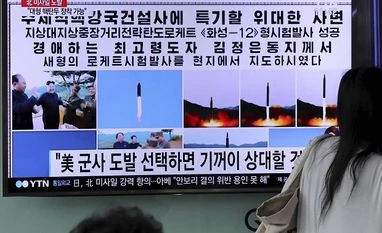 "N Korea says newly tested ballistic missile can carry heavy nuclear warhead")


 Connect with us on WhatsApp