NASA's Juno mission to Jupiter today broke the record to become humanity's most distant solar-powered emissary, when the spacecraft reached about 793 million kilometres from the Sun.
The previous record-holder was the European Space Agency's Rosetta spacecraft, whose orbit peaked out at the 792-million-kilometre mark in October 2012, during its approach to comet 67P/Churyumov-Gerasimenko.
Juno will arrive at Jupiter on July 4 this year. Over the next year the spacecraft will orbit the Jovian world 33 times, skimming to within 5,000 kilometres above the planet's cloud tops every 14 days.
During the flybys, Juno will probe beneath the obscuring cloud cover of Jupiter and study the planet's aurorae to learn more about its origins, structure, atmosphere and magnetosphere.
"Juno is all about pushing the edge of technology to help us learn about our origins," said Scott Bolton, Juno principal investigator at the Southwest Research Institute in San Antonio.
"We use every known technique to see through Jupiter's clouds and reveal the secrets Jupiter holds of our solar system's early history," said Bolton.
"It just seems right that the Sun is helping us learn about the origin of Jupiter and the other planets that orbit it," he said.
Launched in 2011, Juno is the first solar-powered spacecraft designed to operate at such a great distance from the Sun. That is why the surface area of solar panels required to generate adequate power is quite large.
The four-tonne Juno spacecraft carries three 9-metre-long solar arrays festooned with 18,698 individual solar cells.
At Earth distance from the Sun, the cells have the potential to generate approximately 14 kilowatts of electricity.
"Jupiter is five times farther from the Sun than Earth, and the sunlight that reaches that far out packs 25 times less punch," said Rick Nybakken, Juno's project manager from NASA's Jet Propulsion Laboratory in US.
"While our massive solar arrays will be generating only 500 watts when we are at Jupiter, Juno is very efficiently designed, and it will be more than enough to get the job done," said Nybakken.
Prior to Juno, eight spacecraft have navigated the cold, harsh underlit realities of deep space as far out as Jupiter. All have used nuclear power sources to get their job done.
Solar power is possible on Juno due to improved solar-cell performance, energy-efficient instruments and spacecraft, a mission design that can avoid Jupiter's shadow, and a polar orbit that minimises the total radiation.
Juno's maximum distance from the Sun during its 16-month science mission will be about 832 million kilometres, an almost five per cent increase in the record for solar-powered space vehicles.

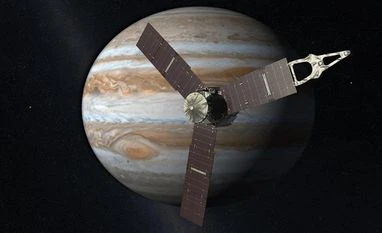 "NASA's Juno spacecraft breaks solar power distance record")


 Connect with us on WhatsApp