
India successfully test-fires nuclear-capable Agni-IV missile in Odisha
The indigenously developed sophisticated Agni-IV having 4,000 km strike range is a two-stage missile. It is 20 meter long with a weight of 17 tonnes
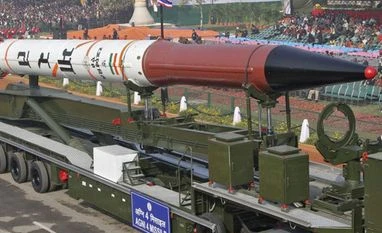 "India successfully test-fires nuclear-capable Agni-IV missile in Odisha")
WebinarsNew
Deep DiveNew
Explore Business Standard
The indigenously developed sophisticated Agni-IV having 4,000 km strike range is a two-stage missile. It is 20 meter long with a weight of 17 tonnes
India on Sunday successfully test-fired its nuclear-capable long-range ballistic missile Agni-IV, with a strike range of 4,000 km, as part of a user trial by the Army.
The strategic surface-to-surface missile was flight tested from launch complex-4 of the Integrated Test Range (ITR) at Dr Abdul Kalam Island, earlier known as Wheeler Island, at about 8.35 am, defence sources said.
Describing the trial as a "complete success", they said all mission objectives were met during the test-fire. All radars, tracking systems and range stations tracked and monitored the flight performance of the missile, which was launched with support of a mobile launcher.
Radars and electro-optical systems had been positioned along the coast of Odisha for tracking and monitoring all parameters of the missile, the sources said, adding two naval ships were anchored near the target area to witness the final event.
This was the 7th trial of Agni-IV missile. The last trial conducted by the strategic force command (SFC) of the Indian Army from the same base on January 2, 2018 was successful.
The indigenously developed sophisticated Agni-IV having 4,000 km strike range is a two-stage missile. It is 20 meter long with a weight of 17 tonnes, they said.
"The state-of-the-art missile is equipped with modern and compact avionics to provide high level of reliability and precision," Defence Research and Development Organisation (DRDO) sources said.
Agni-IV missile is equipped with advanced Avionics, 5th generation On Board Computer and distributed architecture. It has the latest features to correct and guide itself for in -flight disturbances, they said.
The accurate Ring Laser Gyro-based Inertial Navigation System (RINS), supported by highly reliable redundant Micro Navigation System (MINGS), ensures the vehicle reaches the target with accuracy.
The re-entry heat shield can withstand temperatures in the range of 4000 degrees centigrade and makes sure
avionics function normally with inside temperature remaining less than 50 degrees centigrade.
Ballistic missiles like Agni-I, II and III and Prithvi have been included in the arsenal of the armed forces, giving India an effective deterrence capability.
First Published: Dec 23 2018 | 12:35 PM IST


 Connect with us on WhatsApp