
Pak economy projected to grow around 5.2 % this year against target of 6.2%
The government of Pakistan has listed fiscal squeeze and low outputs in agriculture and manufacturing sectors among the reasons for slowing down of the economy
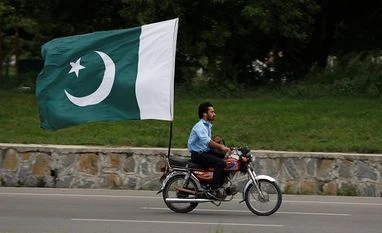 "Pak economy projected to grow around 5.2 % this year against target of 6.2%")
WebinarsNew
Deep DiveNew
Explore Business Standard
The government of Pakistan has listed fiscal squeeze and low outputs in agriculture and manufacturing sectors among the reasons for slowing down of the economy
Pakistan's economy has slowed down for the first time in six years and is expected to grow at around 5.2 per cent this year as against the original target of 6.2 per cent, a media report said Saturday.
The government of Pakistan has listed fiscal squeeze and low outputs in agriculture and manufacturing sectors among the reasons for slowing down of the economy.
In the last fiscal year, the economy grew at a pace of 5.8 per cent the highest in 13 years.
The government has lowered its all major macroeconomic targets and projected that the economy will slow down to around 5.2 per cent this year, 'The Express Tribune' reported.
It emerged during a discussion with the International Monetary Fund (IMF) delegation on Thursday. IMF's Washington-based Mission Chief to Pakistan Harald Finger is leading a staff-level delegation, the report said.
The team kick started its talks and also met with Finance Minister Asad Umar.
The IMF team was informed that due to unleashing of tight fiscal and monetary policies, the economy will slow down in the current fiscal year, said the sources in the finance ministry.
They said that Pakistani authorities have projected 5.2 per cent economic growth rate as against the original target of 6.2 per cent.
"The IMF has not yet communicated its position on Pakistan's revised assessment of 5.2 per cent growth rate," they said.
Pakistan shared its revised macroeconomic indicators with the IMF during the first day of the week-long talks. The government has projected current account deficit of around 4.9 per cent of Gross Domestic Product or nearly USD 14 billion.
The staff-level visit could become a prelude to a formal programme talks, although Pakistan has so far been denying that it is seeking another bailout package from the IMF to deal with the external sector challenges, the report said.
"But in case Pakistan formally seeks a fund programme, a further devaluation of the rupee and an increase in interest rates can become IMF's prior actions," sources in the finance ministry said.
In its March 2018 report on Pakistan, the IMF projected the economic growth rate at 4.7 per cent for the current fiscal year when Pakistan was following expansionary fiscal policies.
The slowing down of the economy for the first time in six years will have direct bearing on jobs creation and quality of lives, the report said.
The 5.2 per cent downward projection is still higher than 4.8 per cent estimated by the Asian Development Bank (ADB) in its report this week.
The agriculture sector is now expected to grow at around 3 per cent rate as against the original target of 3.8 per cent. The industrial output has been projected close to 5.8 per cent against 7.6 per cent original target.
"The services sector that contributes nearly 60 per cent in the total national output may also slowdown to nearly 5.7 per cent," the sources said.
They said that due to devaluation of the rupee, increase in interest rates and imposition of new taxes, the government has also revised upward its inflation target to 6.5 per cent, which many believe is still lower, but is in line with the ADB assessment.
The State Bank of Pakistan is expected to raise interest rates this week, as the Pakistani authorities have decided to contain the overall demand in the economy as part of its economic stabilisation policy.
The last Monetary Policy Committee meeting that was held in July had also highlighted challenges to agriculture and manufacturing sectors.
The industrial output was feared to be affected by depreciation of the rupee and factors like monetary policy tightening, according to the minutes of the committee.
Finance Minister Umar is said to have informed the visiting IMF delegation that after introducing the fiscal measures last week, the government was working on a new structural reforms programme.
He has informed the IMF that the government has imposed additional taxes in addition to increasing the gas prices by 143 per cent.
The sources said the government has projected that the investment in percentage of total size of the economy could remain around 15.2 per cent lower than the original target.
"Similarly, the savings-to-GDP ratio is also expected to remain around 10.3 per cent as against the earlier expectations of 13.1 per cent of GDP," the sources said.
"In spite of the monetary tightening and fiscal consolidation, the current account deficit is still projected to remain close to 5 per cent of GDP," the sources said.
Though the government has taken measures to address worsening trends, these have proved insufficient to arrest the ongoing decline in reserves thus far.
The official reserves held by the State Bank of Pakistan slid by another USD 293 million to USD 9 billion as of end of the last week, according to the central bank.
First Published: Sep 29 2018 | 2:05 PM IST


 Connect with us on WhatsApp