Home / World News / 7.3 magnitude earthquake at Iran-Iraq border kills over 400, injures 7,235
7.3 magnitude earthquake at Iran-Iraq border kills over 400, injures 7,235
According to US Geological Survey, earthquake was centred 31 kilometres outside the eastern Iraqi city of Halabja
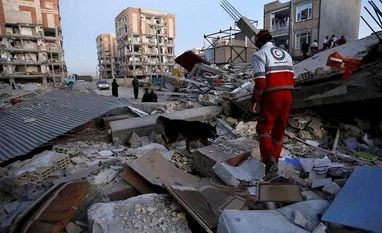
In this photo provided by the Iranian Students News Agency, ISNA, a rescue worker searches debris for survivors with his sniffing dog after an earthquake at the city of Sarpol-e-Zahab in western Iran. Photo: AP | PTI
A powerful 7.3 magnitude earthquake near the Iraq-Iran border killed over 400 people across both countries, sent residents fleeing their homes into the night and was felt as far away as the Mediterranean coast, authorities said on Monday.
Iran's western Kermanshah province bore the brunt of the temblor Sunday night, with authorities saying the quake killed 407 people in the country and injured 6,700. Kermanshah is a rural, mountainous region where residents rely mainly on farming.
In Iraq, the earthquake killed at least seven people and injured 535, all in the country's northern Kurdish region, according to Iraq's Interior Ministry.
The quake was centred 31 kilometres outside the eastern Iraqi city of Halabja, according to the most recent measurements from the US Geological Survey. It struck at 9:48 pm Iran time, just as people began retiring for the night. It could be felt on the Mediterranean coast, some 1,000 kilometres away.
The earthquake struck 23.2 kilometres below the surface, a shallow depth that can amplify damage. Magnitude 7 earthquakes can be highly destructive.
Iranian social media and news agencies showed images and videos of people fleeing their homes. More than 100 aftershocks followed.
The quake's worst damage appeared to be in the town of Sarpol-e-Zahab in Kermanshah province, which sits in the Zagros Mountains that divide Iran and Iraq.
Kokab Fard, a 49-year-old housewife in Sarpol-e-Zahab, said she fled empty-handed when her apartment complex collapsed. "Immediately after I managed to get out, the building collapsed," Fard said. "I have no access to my belongings."
Reza Mohammadi, 51, said he and his family ran out into the alley after the first shock. "I tried to get back to pick up some stuff but it totally collapsed in the second wave," Mohammadi said.
Sarpol-e-Zahab residents said the power and water were out and telephone and cellphone lines were spotty.
Iran's Supreme Leader Ayatollah Ali Khamenei offered his condolences on Monday morning and urged rescuers and government agencies to do all they could to help those affected, state media reported. President Hassan Rouhani is scheduled to tour earthquake-damaged areas tomorrow.
The semi-official ILNA news agency said at least 14 provinces in Iran had been affected by the earthquake. Behnam Saeedi, a spokesman for the country's crisis management headquarters, told two semi-official news agencies that casualty figures stood at 407 killed and 6,700 injured.
In Iraq, Prime Minister Haider al-Abadi issued a directive for the country's civil defence teams and "related institutions" to respond to the natural disaster. Brig. Gen. Saad Maan, an Interior Ministry spokesman, gave the casualty figures for Iraq.
The quake could be felt across Iraq, shaking buildings and homes from Irbil to Baghdad, where people fled into the streets of the capital.

 "7.3 magnitude earthquake at Iran-Iraq border kills over 400, injures 7,235")


 Connect with us on WhatsApp