Reserve Bank of India Governor Raghuram Rajan Saturday called for a system for assessing the wider impact of monetary policies of global central banks, including unconventional tools and their spillover effect, and colour codes for rating them.
Asserting that unconventional monetary policy used by industrialised nations has impact globally, he said there was a need to discuss the issue and analyse its spillover effect.
He suggested a traffic light system grading policies green, orange or red.
Policies having few adverse spillovers should be rated green, those need to be used temporarily and with care could be classified orange and those that can be avoided at all times can be rated red, he said.
Right way to measure spillovers of a policy is to measure their welfare, he said.
Speaking at the Advancing Asia Conference, co-hosted by India and IMF, he said a group of "eminent academics with reasonable representation across the globe" should be set up to analyse and grade various policies.
These could be then discussed at global forums such as the G-20, and eventually lead to possible changes of IMF rules or a new international agreement.
Given the importance of spillovers from monetary policies, especially in the face of globally low inflation, it is important to start building a global consensus on how to get better outcomes for the world, he said.
He, however, warned that a strong policy prescriptions may not be possible soon even with economic analysis of issues at an early stage, as a number of country authorities like central banks have explicit domestic mandates.
"The international community has a choice. We can pretend all is well with the global financial non-system and hope that nothing goes spectacularly wrong. Or we can start building a system for the integrated world of the twenty-first century. I do hope we can consider some initial steps," he said.
Terming monetary policy globally as complicated, the Governor said, that does mean that there should not be any discussion on it.
"As we discuss it, we will develop clearer rules of the game. What makes sense what does not make sense, What is fuzzy and study it better to understand if that can be allowed," he said.
There is no doubt that immediately after the 2008 crisis, unconventional programmes were necessary to repair the financial system, he said.
"The first wave of unconventional policies was absolutely necessary and important for saving the system. After 6-7 years of a policy perhaps we have to examine whether we should keep doing it regardless of the very little evidence of it is having the benefits of what we want," he said.
There has been an impact of unconventional monetary policy on various countries including India, he said.
"As a receiving country, we have seen a lot of volatility (due to unconventional monetary policy followed elsewhere) in the last few years. Often, on the back of different kinds of measures and we are trying to buffer it. One, we followed IMF advice and tried to get our house in order with a lot of focus on macro-stability. That has helped us in the last few bouts of volatility," Rajan said.
Highlighting other measures, the Governor said, India has been trying to encourage longer term flows.
"We have not completely stopped short-term flows, but we have nudged investment in longer ends. That has helped us stabilise inflows. FDI flows are 1.5-2 times of the CAD," he said.
Rajan said there was need to look at the effects of monetary policies adopted by various countries over a period of time.
He said monetary policies of certain countries have adverse impact globally but still there is no open discussion on this.
"So this is the unmentionable monetary policy we don't talk about it. We have veil language often. Sometimes more explicit. But this is the big source of effects in the global economy. I think it is time we brought it out in the open and talked about it without necessarily being on the defensive but trying to understand better what the longer run effects are whether they are moving us in the right direction," Rajan said.
"I would be very happy to be proven completely wrong in my worries about unconventional policies. May be it is the only thing that works, that's working. But let's at least investigate," he said.
The Governor emphasised the need for preparing the integrated world for the 21th century.

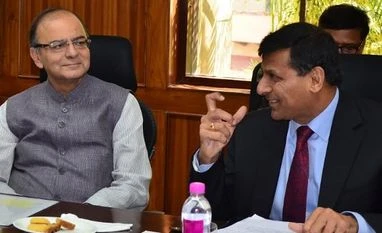 "Raghuram Rajan calls for global rules of conduct for central banks")


 Connect with us on WhatsApp