Home / Companies / News / Ratan Tata personally asked Cyrus Mistry to resign before ouster
Ratan Tata personally asked Cyrus Mistry to resign before ouster
Mistry reduced representation of Tata Sons' directors on the boards of other major Tata Companies
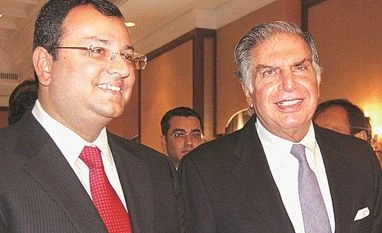
Cyrus Mistry (left), who was sacked as Tata Group chairman in October, with group promoter Ratan Tata in happier times. It has gradually become evident that the bone of contention is not the group per se, rather the control that Tata Trust
Tata Group patriarch Ratan Tata had personally asked Cyrus P Mistry to resign as chairman of Tata Sons as the board had lost faith in him, but his refusal led to the removal via majority vote.
In a para-by-para response to the petition filed by investment firms associated with Mistry's family against his removal, Tata Sons - the holding company of the USD 103 billion salt-to-software conglomerate - told the National Company Law Tribunal (NCLT) that Mistry was removed as Chairman on October 24 last year after "little or no signs of improvement" in his leadership.
Seven out of the nine directors of Tata Sons voted for his replacement after Farida Khambata abstained and Mistry was declared ineligible to vote as he was an interest director.
"Before the commencement of the board meeting of Tata Sons on October 24, 2016, Ratan N Tata and (director) Nitin Nohria personally spoke to Cyrus Mistry and offered Cyrus Mistry an opportunity to resign voluntarily as Executive Chairman. However, Cyrus Mistry refused to do so," Tata Sons said in 204-page affidavit.
Stating that the decision was not taken suddenly or in haste, it said the removal "was the result of a chain of events that led to a growing trust and confidence deficit that had to be addressed without delay".
During his four years at the helm, "several disturbing facts" emerged about his leadership including insufficient details and discipline on capital allocation decisions, slow execution on problems, strategic Plan and Business Plan lacking specificity and follow-through, no meaningful steps to enter new growth businesses and weak top management team.
The affidavit said Mistry was reluctant to accept and fully embrace the terms in the Articles of Association that spelled out the governance structure of Tata Sons and certain rights of the Tata Trusts and the Trust Nominee Directors -- terms which he himself had participated in finalising through extensive meetings and discussions with representatives of the Tata Trusts and external advisers.
Mistry in a "systemic and planned manner" reduced the representation of Tata Sons' directors on the boards of other major Tata Companies.
As several directors of Tata Sons on the board of Tata companies retired, he did not appoint any directors of Tata Sons on the boards of other Tata Companies, as was the practice in the past.
The affidavit said: "This systematic dilution weakened the bind through which Tata values, ethos, governance principles, group strategies were to be implemented across the Tata Group companies.
"In most of the cases, Mistry ensured that he was the only director who was common to Tata Sons and Tata Group companies. Effectively making himself the only 'channel' between Tata Sons and Tata group companies. Mistry's actions were deliberately weakening the Tata Group structure which was inimical to Tata Sons' interest and therefore, the mismanagement, if any has been perpetrated by Mistry.

 "Ratan Tata personally asked Cyrus Mistry to resign before ouster")


 Connect with us on WhatsApp