
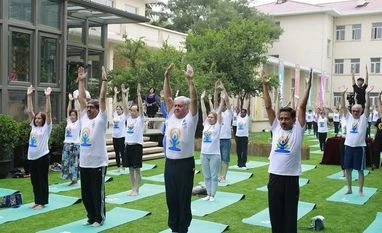
First International Yoga Day event held at Beijing SCO headquarters today
China has a huge Yoga following that celebrates Yoga Day every year with massive gatherings
 "First International Yoga Day event held at Beijing SCO headquarters today")
WebinarsNew
Deep DiveNew
Explore Business Standard
China has a huge Yoga following that celebrates Yoga Day every year with massive gatherings
For the first time, a Yoga event was on Saturday organised at the Shanghai Cooperation Organisation (SCO) headquarters in Beijing, kicking off this year's UN International Day of Yoga celebrations in China.
The United Nations had declared June 21 as the UN International Day of Yoga in 2014. China, which has a huge Yoga following, celebrates Yoga Day every year with massive gatherings, this was the first time that the event was held at the SCO headquarters.
Besides SCO Secretary General Rashid Alimov, Indian Ambassador to China Gautam Bambawale, his wife Amita Bambawale, and diplomats from several countries, as well as Chinese yoga enthusiasts, took part in the event.
The SCO comprises China, Russia, India, Pakistan, Kazakhstan, Kyrgyzstan, Tajikistan, and Uzbekistan. India and Pakistan were last year admitted as full member of the organisation.
"When I think about Yoga, I think about incredible India. Without incredible India, there won't be incredible Yoga. I am very happy we have organised this event for the first time. It is very emotional and very sensitive event with the participation of Ambassador of India to China," Alimov said speaking to PTI after the event.
Alimov, a Yoga enthusiast, said that he thought of organising the event when he visited the International Yoga Centre in Delhi while on a visit to India a few months ago to invite Prime Minister Narendra Modi to take part in the SCO summit, which was held on June 9 and 10.
"After the visit to the International Yoga Centre, I promised to myself to organise the Yoga Day at SCO headquarter. Today, we are very happy about it. We did it. I was little bit nervous about participation as it was a Saturday. We prepared 100 places, but more than 150 turned up," he said.
The participants are from different nations, cultures, and ages. Yoga invited them to be together, he said.
"What it means is Yoga represents the Shanghai spirit. The Shanghai spirit and Yoga spirit are the same. It means people must be together without national and political differences," Alimov said, adding "Yoga is one of the symbols of uniting people, who want to preserve spiritual and physical health".
Anyone can practice Yoga and there is no restriction of age and strength and without national or political differences, he said.
India, which was admitted into the eight-member organisation last year, already contributed a lot to the grouping, he said.
Bambawale, in his address, said India's Yoga techniques have proved to be extremely important in ensuring a healthy and fulfilling life for millions of people across the globe.
"Yoga schools have sprouted all over the world, including in the SCO countries. The practice of Yoga and its benefits are becoming apparent to people in every corner of the world, including here in China where we even have an India-China Yoga School at the Yunnan Minzu University in Kunming," he said.
Mohan Singh Bhandari, the founder of a popular Yoga institution in China, Yogi Yoga, conducted the exercises.
First Published: Jun 17 2018 | 12:51 AM IST


 Connect with us on WhatsApp