Home / India News / Thais vote on new constitution that could dilute democracy
Thais vote on new constitution that could dilute democracy
The main criticism of the draft constitution includes at least five years of a transitional period and a 250-member appointed Senate that includes the commanders of the army and other security services
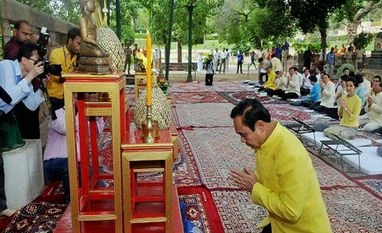
Thailand Prime Minister Prayut Chan-o-cha, prays under the Sacred Bodhi Tree at Mahabodhi Temple in Bodhgaya. His wife Naraporn Chan-ochato is also seen. <b>Photo: PTI</b>
Thais voted today in a referendum on a new constitution that critics say is tailor-made for the military government to stay in control for several years and entrench a new, quasi-democratic system that gives vast powers to appointed officials.
The junta, which came to power in a May 2014 coup and ordered the constitution rewritten, says the new version will usher in a new era of clean politics and stable democracy in a country chronically short of both in recent years, sometimes sliding into violent internal political conflict.
Still, the government of Prime Minister Prayuth Chan-ocha, a retired army general, used its sweeping powers to ban political rallies, independent campaigns against the draft constitution and virtually no debates on it.
Opponents say this was done to ensure that people would have little knowledge about the constitution's provisions, even though 1 million copies are claimed to have been distributed to the public in a nation of 64 million people.
More than 100 people who tried to campaign against the referendum on social media have been thrown in jail, and open criticism has been made punishable by up to 10 years in prison.
At a polling booth in Bangkok where Prayuth is scheduled to vote, officials displayed an empty ballot box to reporters and sealed it before letting the first voter a young woman enter the booth. She first registered at a desk and signed a paper before casting her ballot.
People are being asked to check "yes" or "no" for the constitution and related provisions on the ballot paper. Final results are expected late today.
The main criticism of the draft constitution includes at least five years of a transitional period and a 250-member appointed Senate that includes the commanders of the army and other security services. A deadlock in the 500-member elected lower house could trigger a selection of a prime minister who is not an elected member of parliament.
Also, emergency decrees enacted by the junta without any parliamentary consent remain valid. So-called independent bodies, stacked with conservative appointees, would hold "disproportionately broad and unchecked powers" over elected politicians, said the international human rights consortium FIDH and the Union for Civil Liberty in Thailand.
"The draft charter creates undemocratic institutions, weakens the power of future elected governments, and is likely to fuel political instability," they said in a report. Even if Thais vote "no," the military will remain in control for the foreseeable future. Prayuth has promised to hold elections next year, without elaborating on how that would happen if voters reject the draft constitution.
Thailand has endured 13 successful military coups and 11 attempted takeovers since it replaced absolute with a constitutional monarchy in 1932. If passed, this would be Thailand's 20th constitution.

 "Thais vote on new constitution that could dilute democracy")


 Connect with us on WhatsApp