
Trump predicts 'good chance' of China trade deal on Day 2 of negotiations
Trump again said he was considering pushing back the deadline for raising tariffs on more than $200 billion in Chinese exports
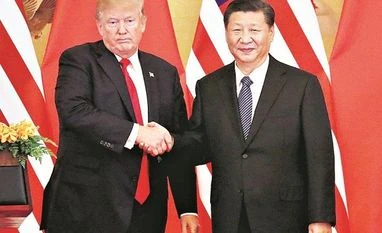 "Trump predicts 'good chance' of China trade deal on Day 2 of negotiations")
WebinarsNew
Deep DiveNew
Explore Business Standard
Trump again said he was considering pushing back the deadline for raising tariffs on more than $200 billion in Chinese exports
US President Donald Trump on Friday said a trade summit with Chinese leader Xi Jinping was likely to occur next month, and hailed two days of "very good talks" by negotiators.
The talks were extended through Sunday as officials race to reach a deal ahead of a deadline next week when US duty rates are due to rise sharply.
But Trump again said he was considering pushing back the deadline for raising tariffs on more than $200 billion in Chinese exports.
"We expect to have a meeting sometime in a not too distant future," he said of the meeting with Xi.
"Probably fairly soon in the month of March." Details remained scant about any concrete progress in the seven-month-old trade war, which has rattled the global markets and prompted stark warnings about the risks to the world economy.
"I think there is a very, very good chance that a deal can be made," Trump told reporters at the White House on a second day of trade negotiations with Chinese officials.
"If we are doing well, I could see extending that" deadline for the end of the three month tariff truce.
And Trump said an agreement on currency manipulation will be included in the trade pact. Officials from Beijing also expressed optimism about a positive outcome.
"From China, we believe that it is very likely that it will happen," Chinese trade envoy Liu He said, speaking through an interpreter.
Global stock markets were higher on expectations the two sides would avoid further deterioration in their trade relations.
Analysts say the two sides are likely to trumpet mutual agreements to resolve the easier parts of the trade dispute -- increasing purchases of American goods, more open investment in China and tougher protections for intellectual property and proprietary technology.
The harder parts covering issues like scaling back China's ambitious industrial strategy for global preeminence, are another question.
Christine Lagarde, head of the International Monetary Fund, again warned that the US-China trade tensions a "major risk" to world economic growth.
Since July, the countries have hit out with tariffs on more than $360 billion in two-way trade.
While the tariffs alone are having "minimal" effect on global trade, they are damaging business confidence and weighing on stock markets, Lagarde told the US radio program Marketplace on Thursday.
"I cross my fingers every morning and my toes every evening because I hope that it is going to end up with a way to fix the system, not break it," she said The IMF has cut its forecast for global growth this year due to the combined impact of the trade war.
Beijing reportedly has proposed an increase in its imports of US energy and agricultural exports significantly. US Agriculture Secretary Sonny Perdue tweeted that China has committed to buying "an additional" 10 million metric tons of soybeans as a "show of good faith," but he did not give any details or specify the timeframe.
Still, a broader deal could be difficult given the US demands for far-reaching structural changes.
Gary Clyde Hufbauer, a trade expert at the Peterson Institute for International Economics, said China may have to remove its tariffs in order to increase purchases of US goods, but Trump may feel no pressure to roll back the duties he imposed last year.
"The big surprise would be a complete removal of tariffs by Trump but I'm expecting an asymmetrical removal of tariffs by China in order to get to some of these numbers," he said.
China's retaliation has hit US farm exports hard. The US Agriculture Department estimated this month that US soy exports would not turn to their pre-trade war levels for another six years.
William Reinsch, a former senior Treasury official for trade in the administration of President Bill Clinton, told AFP a risk for Trump is whether any agreement holds and the Chinese honour their commitments.
"If it unravels and we have a string of unmet commitments and then US retaliation right before the election, we're kind of right back where we started," he said.
First Published: Feb 23 2019 | 5:20 AM IST


 Connect with us on WhatsApp