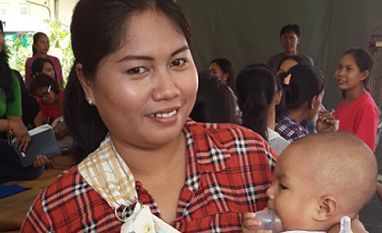
As she rocks her restless baby, Tia Pertiwi listens as three women with aprons imprinted with images of the reproductive system explain how contraception works.
Besides her are some 20 odd women, most of them market vendors, and the atmosphere is relaxed and carefree with many asking questions and cracking jokes.
Pertiwi, 25, who recently gave birth to her first child, wants to delay the second by a few years but is not sure what birth control method to adopt.
Fortunately, the answers are available close at hand; at the Pasar Badung marketplace where Tia works at a fruit stall.
Guiding her with information about contraceptive options is the Yayasan Rama Sesana, a health clinic situated inside Pasar Badung, a traditional marketplace in the Bali capital Denpasar, where Tia works as vendor at a fruit stall.
Since 2004, YRS, a non-profit, sexual and reproductive health clinic has reached out to thousands of low-income group women in Bali. Most of them, like Tia, work in traditional market communities with an average daily income of US$5.
The YRS started in 1999 and initially worked in the field of AIDS prevention among risk groups in 1999. It later developed a plan to open health centers to provide information and services on breast and cervical cancer prevention, HIV/Aids, family planning, prenatal care and sexually transmitted infections.
“Breast cancer is the leading cause of cancer-related deaths in Indonesia and over 9000 women die of cervical cancer in our country every year”, says Dr Luh Putu Upadisari, founder, YRS. “Early detection is key to prevention but women lack information and they don’t have the time and money, especially towards preventive care”.
To ensure maximum reach, these health clinics were set up at traditional marketplaces. “They are open 24 hours a day and thousands of people - girls, women, and housewives in particular - come here. This creates a supportive environment to inform them about their reproductive health and empower them,” says Upadiseri.
The YRS has two such clinics at Bali and also runs mobile clinics that carry out monthly visits to markets around Bali. The services offered are on a donation basis and include breast exams, Pap smears, STI and HIV testing, and counseling.
The centers report about 520 clients per month on average – over 67% are women. Their location draws a wide variety of clients - not just market vendors but laborers, cleaners, office workers and shoppers.
Trusting women with information about their health not only empowers them but also helps save lives. And the Balinese approach of reaching women directly at their workplace is one that has the potential to benefit thousands of women in India as well.
Like Indonesia, India reports a high death incidence due to cervical cancer. According to a 2014 study by the Cervical Cancer-Free Coalition, it tops the world in cervical cancer deaths with nearly 73,000 women dying every year. It is also the second most common cancer in women aged 15–44 years.
Cervical cancer is treatable if found early but in the absence of a nationwide screening program in India, there are widespread disparities in screening, treatment as well as survival.
“Early detection is essential as it is completely curable at that stage but we do not have a comprehensive screening program with the outreach required to provide access to services to underprivileged women”, says Dr Aparna Hegde, founder of NGO ARMMAN, which is behind several maternal health initiatives in Mumbai and other parts of the country.
ARMMAN’s mMitra project uses mobile phone technology to take preventive health care information directly to the phones of pregnant women through pregnancy and infancy.
Hegde says innovative approaches could offer the way forward as traditional models of caregiving leave a lot to be desired.
“Initiatives like YSR emphasize preventive care and this paradigm shift essential because our health care system has almost always focused on curative services”, adds Hegde. “Preventive care will prevent overloading of our public health system and help them provide better care to the patients who access it. “
Shai Venkatraman is a Mumbai-journalist and blogger who writes about issues related to public health and gender equality, on her blog,
Healthy Living, a part of Business Standard’s platform,
Punditry.

 "Taking community health to the market")


 Connect with us on WhatsApp