
Japan's central bank governor says Fed rate hikes good for global economy
He also said an ageing population could pose structural challenges for central banks
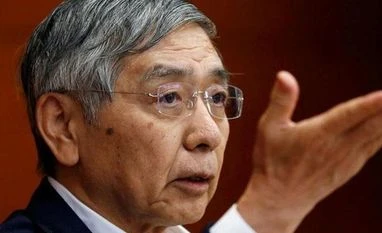 "Japan's central bank governor says Fed rate hikes good for global economy")
Explore Business Standard
He also said an ageing population could pose structural challenges for central banks
Bank of Japan Governor Haruhiko Kuroda said on Saturday steady interest rate hikes by the Federal Reserve were "basically good" for the world economy, shrugging off concerns that higher U.S. rates could hurt Asian economies by triggering capital outflows.
Kuroda, however, was more cautious about the risks posed by escalating trade tensions, which he described as of a "rather unusual" scale and a "new development" for the global economy.
He also said an ageing population could pose structural challenges for central banks, as it undercuts their economies' growth potential and require them to use more monetary firepower than before to reflate growth.
The International Monetary Fund's steering committee warned earlier on Saturday that tighter financing conditions were among risks that could affect many emerging and developing countries.
Kuroda, however, said higher U.S. rates were positive for the global economy because the Fed's policy normalisation showed the U.S. economy was in good shape.
"It's good that the United States is normalising monetary policy, because the economy is growing and inflation is already near (the Fed's) target," Kuroda said at a seminar hosted by IMF during the annual meetings of the fund and the World Bank in the Indonesian resort island of Bali.
"Gradual normalisation with a clear statement of (the Fed's) intention and future policy ... That's basically good for the world economy."
Kuroda said the BOJ was facing a different challenge than that of the Fed as it was taking longer to achieve its 2 percent inflation target, reiterating his resolve to maintain a massive stimulus programme in Japan for the time being.
An ageing population may also pose "serious challenges" for many countries as it could require central banks to cut rates more than before to boost their low-growth economies, he said.
"Ageing society is seen not only in Japan but in many European and emerging countries. It's becoming a common challenge," Kuroda said.
"An ageing population tends to reduce medium-term growth potential ... This would make monetary policy more challenging in the future."
First Published: Oct 13 2018 | 2:22 PM IST

