
Help wanted: Modi's 'Make in India' drive lacks skilled labour
Lack of vocational training, outdated courses big questions to PM's manufacturing push
 "Help wanted: Modi's 'Make in India' drive lacks skilled labour")
WebinarsNew
Deep DiveNew
Explore Business Standard
Lack of vocational training, outdated courses big questions to PM's manufacturing push
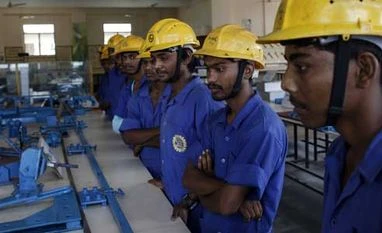
In a classroom of construction firm Larsen & Toubro's training centre outside Mumbai, an instructor lifts up a tool and shows it to his students: "Clawhandle," he tells them.
"Clawhandle," chant back the young men, gathered under a picture of Vishwakarma, the Hindu god for craftsmen.
Prime Minister Narendra Modi is depending on such young people to realise his dream of turning India from a country of IT professionals, security guards and low-paid chauffeurs into a manufacturing and export powerhouse through his "Make in India" initiative.
India has too few skilled labourers thanks to decades of neglect in training and it desperately needs electricians, bricklayers and plumbers.
The shortage means the country could squander the potential demographic dividend of 12 million people joining the labour market a year, just when China's workforce is expected to lose 6 million over the next decade because of its ageing population.
"India, so far, has been a country that celebrated knowledge and intellect. Skills are not celebrated," said Rituparna Chakraborty, president of Indian Staffing Federation, which represents the country's employment agencies.
China became a manufacturing giant by steering secondary school students into formal skilled training programmes.
By contrast, in India, students who do not go on to tertiary education have few vocational options other than government-run Industrial Training Institutes (ITIs) that executives say are poorly managed and often outdated.
For example, the ITI syllabus for car mechanics includes considerable training on carburettors, which were widely phased out of cars in the 1990s.
The scant training available means that India only has 3.5 million workers undergoing skills courses a year, compared with 90 million in China, according to Indian government data.
The lack of proper training is compounded by prejudice against manual labour under the Hindu caste system, which has traditionally left jobs that might get your hands dirty to the lowest of the low.
As a result, only one in 10 workers in India's construction industry are skilled, according to government data.
PRIVATE COMPANIES FILL THE GAP
The government has a goal to provide at least some skills to 500 million people by 2022. But private companies such as the Godrej Group are taking matters into their own hands, recruiting and training workers themselves to be ready with skilled labour when an economic recovery comes.
"I always say that there is no unemployment in India. It's only unemployability," said Adi Godrej, whose businesses range from consumer goods to real estate and infrastructure.
Larsen & Toubro (L&T), the country's biggest construction company, says it could face a labour shortage next year, just when it plans to ramp up investment after two years of slow economic growth.
It has gone out to rural areas to find recruits and bring them to sprawling training centres - such as the one in the outskirts of Mumbai, where young men practice bricklaying and putting up scaffolding - from which up to 20,000 students graduate a year, many of them joining L&T.
Yogesh Devdas Dudhpachari, 24, is one of L&T's recruits. An unskilled motorcycle mechanic, he attended an ITI to learn carpentry but ended up back at his village without a job before being taken on by L&T.
"Skill and time is valued here," he said during a break in his training. "We were not doing anything in our villages."
Even then, companies struggle to find volunteers.
Most young people eschew building and manufacturing jobs in favour of less physically strenuous work, despite data showing that wages for professions with acute shortages such as plumbers and electricians are higher than even low-level IT engineers.
At L&T's training centre in Mumbai, 25% of people who joined this year have left the three-month training course.
"There is a bit of reluctance ... to join this kind of trade," said Ajit Singh, executive vice president of L&T's Corporate Infrastructure and Services. "The rural youth are used to staying in their comfort zones in the villages and don't want to move out to the project sites."
Analysts say the biggest push needs to come from the government, which has already started easing decades-old labour rules and is trying to centralise a hodgepodge of bodies that over-regulate employment.
Modi has also vowed to make skills training a major plank of his "Make in India" initiative, passing through parliament a programme that will make it easier for employers to hire apprentices for two years.
Economists say India needs to go beyond numerical targets for skills training by lifting the quality of ITIs and working with the private sector to improve apprenticeship programmes.
"The initiatives are in the right direction," said Chetan Ahya, Morgan Stanley's Asia-Pacific chief economist.
"However, alongside focusing on the quantitative aspect of skilled labour force the policy makers will also need to focus on the qualitative aspect of the skill programmes."
First Published: Dec 30 2014 | 8:42 AM IST


 Connect with us on WhatsApp