Honda Motor Co Ltd and Hitachi Ltd’s auto parts subsidiary plan to form a joint venture to develop, produce and sell motors for electric vehicles (EV), joining forces to better compete in the highly specialised “green” car segment.
Automakers are increasingly teaming up with parts suppliers to build components for the fast-growing EV segment as a way to expand product line-ups while containing high development costs.
“Producing motors is capital intensive, so rather than just manufacturing them for our own purposes, we would like to produce in large volumes with the possibility of supplying a variety of customers,” Honda Chief Executive Officer Takahiro Hachigo told reporters at a news briefing on Tuesday.
“In pairing up with Hitachi, we’re hoping to tap into its expertise in volume production.”
The venture will be established in July with an investment of 5 billion yen ($44.69 million), and will be 51 per cent owned by Hitachi Automotive Systems Ltd and 49 per cent held by Honda, the two companies said.
It will build motors to be used in petrol hybrids, plug-in hybrids and battery-electric cars, and will have sales and manufacturing functions in the United States and China in addition to Japan, they said. Hitachi Automotive Systems is a wholly owned subsidiary of Hitachi Ltd and longtime supplier of components including engine and brake parts to Honda.
It counts the alliance of Nissan Motor Co Ltd and Renault SA as its biggest client, accounting for around one-third of annual sales. Other customers include Toyota Motor Corp, Ford Motor Co and Volkswagen AG.
The tie-up highlights Honda’s willingness to join with other industry players as it competes to develop more lower-emission cars. It comes after Honda’s announcement last week that it was teaming up with General Motors Co to produce hydrogen fuel cell power systems in the United States from around 2020.
“It’s a reflection that a lot of the new technologies being developed for automobiles are not cheap, so companies are finding partners that they can share the burden with to reduce their risk,” said Janet Lewis, managing director of equity research at Macquarie Capital Securities Japan. reuters
“Nobody knows exactly where the industry is going to go, so everybody has to have a variety of solutions. It’s a way of preparing for the unknown.”
The latest joint ventures by Japan’s third-biggest automaker are part of its strategy for new-energy cars to comprise two-thirds of its vehicle line-up by 2030 from around 5 percent now.
Honda is planning to launch battery-powered and plug-in petrol hybrid versions of its Clarity fuel-cell vehicle later this year. It does not currently market a battery-electric vehicle after discontinuing a limited production electric version of its Fit mini MPV model in 2014.
Grand venture
* 5 billion yen ($44.69 million) Investment made when the venture will be established in July
* 51 % will be owned by Hitachi Automotive Systems
* 49 % will be held by Honda
* It will build motors to be used in petrol hybrids, plug-in hybrids and battery-electric cars
* Venture’s sales and manufacturing functions will be in the United States and China in addition to Japan

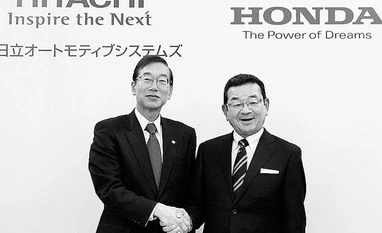 "Honda plans e-car venture with Hitachi")


 Connect with us on WhatsApp