
US industrial output falls as manufacturing stays flat
Industrial output slipped 0.6% after a downwardly revised 0.4% dip in October
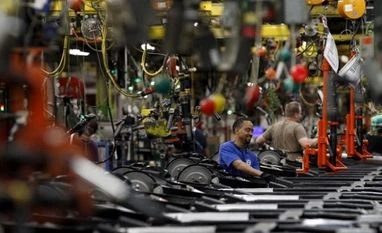 "US industrial output falls as manufacturing stays flat")
WebinarsNew
Deep DiveNew
Explore Business Standard
Industrial output slipped 0.6% after a downwardly revised 0.4% dip in October
US industrial production saw its sharpest decline in more than three and a half years in November as utilities dropped sharply, a sign of weakness that could moderate fourth-quarter growth.
Industrial output slipped 0.6 percent after a downwardly revised 0.4 percent dip in October, the Federal Reserve said on Wednesday, marking the third straight month of declines.
Economists polled by Reuters had forecast industrial production slipping 0.1 percent last month.
The drop in output - the steepest since March 2012 - reflected a 4.3 percent decrease in the utilities index, a likely result of mild weather this season as fewer households switched on heating or air-conditioning.
The mining index fell 1.1 percent, standing 8.2 percent lower than the same time a year ago.
Total manufacturing output, however, remained unchanged, bolstered by gains in nondurable goods particularly in the food, beverage and tobacco products category. Analysts had expected manufacturing to tick up 0.1 percent, according to a Reuters poll.
Durable goods declined 0.2 percent overall, with the largest drops in categories including electrical equipment and motor vehicles.
The industrial sector has been hampered by a slowdown in global growth, low commodities prices and a strong dollar, which have reduced overseas demand for U.S. manufactured products.
With output declining, the percentage of industrial capacity in use fell to 77.0 percent from an unrevised 77.5 percent in October.
The U.S. central bank views capacity use as a leading indicator in deciding how much further the economy can grow before sparking higher inflation.
The report came as the Federal Reserve's policy-setting committee met for a second day. The U.S. central bank, encouraged by a tightening labor market and strong domestic demand, was widely expected to raise interest rates for the first time in a decade at the meeting.
First Published: Dec 16 2015 | 7:54 PM IST


 Connect with us on WhatsApp