Wall Street cuts losses as Larry Kudlow promises China trade talks
Wall Street dropped sharply at the open on fears of an escalating trade war between two countries after Trump threatened to slap an additional $100 billion in tariffs on Chinese goods
Reuters US stocks recouped some losses on Friday morning after President Donald Trump's top economic adviser Larry Kudlow said negotiations between the United States and China over trade differences would start soon.
Wall Street dropped sharply at the open on fears of an escalating trade war between two countries after Trump threatened to slap an additional $100 billion in tariffs on Chinese goods and Beijing warned it would fight back "at any cost" with fresh trade measures.
Kudlow said on told Bloomberg TV that while trade talks with China have not yet begun but will hopefully start in the next few months.
John Doyle, vice president of dealing and trading at Tempus in Washington said the equity markets have experienced the bulk of the volatility from the Trump administration's mixed signals, but that the currency markets seemed unperturbed.
"For the most part, currency markets seem to be taking the tit-for-tat trade war threats with a grain of salt.
At 9:51 a.m. ET, the Dow Jones Industrial Average dropped 0.37 percent to 24,414.88. The S&P 500 fell 0.31 percent to 2,654.7 and the Nasdaq Composite declined 0.26 percent to 7,058.23.
The list of decliners were similar to Wednesday's, when the United States and China announced tariffs on $50 billion of each others' imports.
Boeing, the single largest U.S. exporter to China, fell 1.12 percent. Caterpillar declined 1.3 percent and Deere dropped about 2 percent.
Chipmakers, which as a group rely on China for about a quarter of their revenue, also declined. The Philadelphia semiconductor index fell 0.54 percent.
Eight of the 11 major S&P sectors were lower, led by a 0.6 percent drop in financial stocks as the case for further rate hikes dimmed after soft jobs data.
Nonfarm payrolls increased by 103,000 last month, the Labor Department said, the fewest in six months and lower than economists' forecast of 193,000 jobs.
Average hourly earnings rose eight cents or 0.3 percent last month, above the expected 0.2 percent increase. The unemployment rate held steady at 4.1 percent for a sixth straight month.
"That's not showing us wage inflation where the Fed would have to step in. This seems to be a natural improvement," said Sean Lynch, co-head of global equity strategy, Wells Fargo Investment Institute in Omaha, Nebraska.
Investors will also tune into Fed Chairman Jerome Powell's speech at an event later in the day for signs the central bank could raise rates more than the expected two more times this year.
Declining issues outnumbered advancers on the NYSE for a 1.41-to-1 ratio and for a 1.28-to-1 ratio favouring decliners on the Nasdaq.

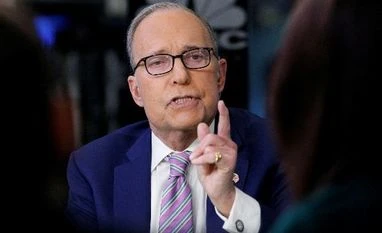 "Wall Street cuts losses as Larry Kudlow promises China trade talks")

