A wooden camera stands mounted on a beautifully crafted tripod. Next to it are rows upon rows of curious cameras, some so large that they have in-built darkrooms, others small enough to be carried easily. A walk-through the Museo Camera is like taking a step back in history, bringing the visitor face to face with a long gone past. “It’s only when people like us actually see vintage cameras and photographs that we realise how skilled olden-day photographers were,” says Aditya Arya, veteran photographer and curator of Museo Camera, the only vintage camera museum open to public in India. “They understood the mechanics of their cameras, developed and printed their own photos and constantly tried to balance the huge cost of taking and printing photographs with their artistic instincts. In contrast, today the camera does the thinking for the photographer, who has the huge added luxury of being able to take a million shots in search for that perfect image!”
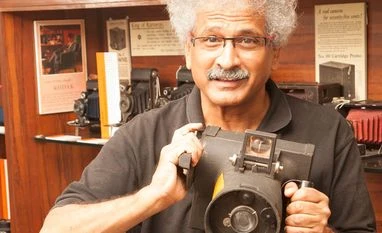
Arya walks me through the museum, currently housed in the basement of his house in Gurgaon. On display are cameras dating back to the late 1800s, arranged not by date but by make, each representing iconic moments in the history of photography. On display, with detailed captions, are studio, field, and portable cameras manufactured by companies such as Eastman Kodak, Leica, Ansco, Zeiss, Graflex and Thornton Picard between 1880 and 1990. “Captioning is an on-going, time-consuming process here,” says Arya. “Using my extensive library and Internet resources, we’re constantly researching each exhibit. Yet there are a few that are yet to be labelled.”
We pause in front of a beautifully crafted box camera with an inbuilt darkroom. “The word camera originates from the Urdu word kamra, room,” he says. “I remember seeing commercial photographers with such cameras in old Delhi, they’d take your picture, develop it and hand it to you in 20 minutes,” says he. Over 70 per cent of the cameras on display at Museo Camera are in working order or can be repaired. “A group of photographers wants to use these cameras again and exhibit the results. However, I’m constrained by space, time and, of course, money,” says he.
An integral part of the museum is Arya’s collection of 20,000 original silver prints chronicling India’s freedom movement. “These are a legacy from a family friend, Kulwant Roy, who used to be a freelance photographer at that time,” says Arya. The negatives were in a sad state when Arya began the arduous task of repairing them and printing some of them, supported by Indian Council for Cultural Relations and Suresh Neotia, chairman of Ambuja Cements. The back-breaking work has been worth it. Of these, 227 images are now part of the national collection.
Over 70% of the cameras on display at Museo Camera are in working order or can be repaired
Looking at the extensive collection of cameras, photography equipment and images, it seems incredible that Museo Camera is self-funded. Some cameras have been donated by friends and acquaintances, but almost 85 per cent of Arya’s stock comes from kabadiwalas. “I’ve been buying from them since I was in college. Of course, they’ve also become tech-savvy now,” he says, showing me WhatsApp images that kabadiwalas across the country send him. “They find me online and send me pictures of what they have,” says Arya. With over 500 cameras and counting, Museo Camera is now bursting at its seams, but Arya still can’t resist a good find. Once a kabadiwala sent him a picture of an old camera he hadn’t seen before. “When I saw its model number, I was amazed! This model used to be mounted on bomber aircraft in World War II to take pictures of the damage bombs wreaked,” he adds passionately. “He had two pieces, I bought them both.”
Vintage cameras aren’t mere curiosities in the modern digital era. “Photography as an art is inextricably linked to its craft, its technology,” says Arya. Further, tracing the evolution of the camera has immense historical and technical value. “I see this museum as a significant education tool for photographers and students. Modern day photography has its roots in right here… . Did you know, for instance, the popular photo software Light Room originated from the principles of the old dark rooms?"
There’s a lot that students and aficionados of photography can learn here, not just about the evolution of photography but also about how it was practised. “It fills me with wonder to think how carefully these photographers must have visualised each shot, knowing that they'd get no second chances, no retakes.” says Arya, gazing at a silver bromide print of a young Jawaharlal Nehru cupping his hands to light a cigarette. Minutes turn into hours as the old cameras spin tales of cultures past and people long gone.
Museo Camera: T23/5, Dlf City Phase III Gurgaon, Gurgaon – 122010. Open from Monday to Saturday, 9.30 am to 6.30 pm. Call +(91)-9810009099 for appointments

 "A camera museum that offers a history lesson in every click")


 Connect with us on WhatsApp