The most extraordinary thing about the exhibition, “Sultans of Deccan India, 1500-1700: Opulence and Fantasy”, that opens next month at New York’s Metropolitan Museum of Art (popularly known as “the Met”) is that it’s happening at all.
As historians know well, the output of the five sultanates of the Deccan that flourished between the late 15th and the late 17th century, well before the princely state of Hyderabad came into being, was dazzling. The world’s earliest diamonds were mined in this region, of which the finest came to adorn European, Ottoman and Mughal royalty. Its prized painted and dyed textiles went westwards to Europe and eastwards to Southeast Asia. The Deccan courts attracted Persian painters, European traders, Portuguese doctors, Maratha warriors and military slaves from Ethiopia, who, unusually, came to enter the nobility.
In an essay in the exhibition catalogue, historian Richard M Eaton says that these influences created “an aura of dynamism, diversity and cosmopolitanism that was perhaps unique in the early modern world... and shaped a moment of great artisitic creativity”. The sultanates — Ahmednagar, Berar, Bijapur, Golconda and Bidar — produced paintings , architecture, manuscripts, textiles, calligraphy and metal-work of great aesthetic power.
But there is a postscript to this tale: relatively few portable treasures survive from these courts, which fell to the Mughals amid great destruction in the late 17th century. What remains is widely scattered across the world, some in public collections and a major part in the hands of private collectors. Sourcing and understanding the material, and persuading owners to lend has, in some cases, taken years.
That, explains Navina Haidar, curator of Islamic Art at the Met, is why this show, infused with the romantic promise of reuniting under one roof objects that have been apart for centuries, takes place 15 years after the idea was born. The contemporary relevance of Deccani cosmopolitanism and the sheer quality of its artistry were the reasons for pushing on with an exhibition that has cost a few million dollars. “But such an exhibition,” Haider says, “may never happen again in our lifetime. This is one of the hardest categories of art to curate.”
Most extraordinary thing about the exhibition, “Sultans of Deccan India, 1500-1700: Opulence and Fantasy”, that opens next month at New York’s Metropolitan Museum of Art (popularly known as “the Met”) is that it’s happening at all
The 200-odd offerings in this exhibition, which runs from April 20 to July 26, are from some 60 institutional and private lenders from across India, West Asia, Europe and North America. The booty includes a few of the oldest diamonds in the world with intriguing names such as the Shahjehan Diamond, the Agra Diamond and the Idol’s Eye diamond. Their cutting styles highlight differences between Indian and Western aesthetics. Their lineages trace journeys of wealth and power, with ownership travelling from Mughal rulers to Victorian aristocracy, and finally to West Asian sheikhdoms — via, in one case, Imelda Marcos, widow of former Philippine president Ferdinand Marcos. The collection also features a hairpin with a Golconda diamond gifted by the British monarch, Charles II, to his mistress, Nell Gwynne. While generating support for the exhibition, Met officials pointed out to patrons that that there were bits of the Deccan in American life too: Elihu Yale, whose legacy laid the foundations of Yale University, had traded in Deccani diamonds.
Rivalling the luminosity of the Deccani gems is a feast of sublime paintings. In particular, this exhibition brings together some of the best examples of the fantastical, ethereal Bijapuri paintings, including those from the vibrant court of the legendary ruler, Sultan Ibrahim Adil Shah II. Many feature the romantic figure of the Sultan, a poet-mystic-musician who venerated the goddess Saraswati in dreamy contemplation, or the Sultan in procession or astride his favourite elephant, Atash Khan.
Even relatively mundane exhibits have fascinating back stories. A set of eight decorative metal parts, or finials, belonging to one palanquin, was owned in the 1920s by one Hyderabadi nobleman, but its parts went their separate ways, and have now been reunited from five different private collections in New York and London.
It is striking that less than one-tenth of the exhibits are from India. There are many reasons. Deccan paintings, manuscripts, textiles, and other objects travelled widely, in their time, due to trade, finding their way into European treasuries and churches. Other works became the booty of Mughal conquerors, and their Rajput allies, and got further dispersed, through conquest and as gifts to the powerful in Iran, Russia and Turkey. Some Deccan treasures also departed from Indian shores during British rule.
However, Naman Ahuja, professor of art and aesthetics at Jawaharlal Nehru University, New Delhi, points out that for several decades after Independence, Western art connoisseurs and dealers did manage to collect avidly in the Deccan. “Indian institutions and individuals never really went out and collected, which is why, while we have a few important things, the A plus-plus category of Deccan art is abroad.” Even the scholarly work on Deccan art, he observes, has been West-led.
Ibrahim Roza, Bijapur
What India has in profusion is, of course, Deccan architecture: hundreds of forts, palaces, tombs, mosques that have been widely photographed for the Met exhibition. Ahuja hopes this gathering of the treasures of the Deccan in New York “will send alarm bells ringing in India at the manner in which this historical topography is being obliterated by rapid urbanisation”.
While Indian sources, such as the National Museum, the Rampur Raza Library and the Jagdish and Kamla Mittal Museum of Indian Art, are dispatching some of their Deccan treasures, a Pune-based institution has reneged on a commitment to send an important manuscript. Shortly before a National Museum official was to collect the 16 century Tarif-i Husain Shahi for the Met’s exhibition, its owner, the Bharat Itihas Sanshodhak Mandal, withdrew permission. Its director, S M Bhave, says this was on account of strong protests by local historians that the manuscript’s safety would be compromised if it went abroad.
Visitors may not notice the omission, though, as they travel through an illusionistic space, inspired by the white arched interiors of the great mosque in Gulbarga, and then onto separate sections on the sultanates, suffused with the pinks, greens, mauves, and pale yellows of Deccani textiles. “These are not the hot colours of north India, but a very distinctive colour palette in which the south of France meets India,” promises Haidar. An apt metaphor for the cosmopolitan world of the Deccan sultans.
“Sultans of Deccan India, 1500-1700: Opulence and Fantasy” will be held at New York’s Metropolitan Museum of Art between April 20 and July 26

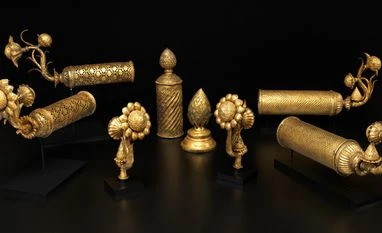 "A New York museum will celebrate Deccan sultanate's golden age")


 Connect with us on WhatsApp