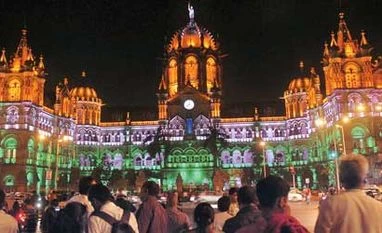
Every evening for the past few months, cars travelling opposite Mumbai's Chhatrapati Shivaji Terminus watch out for camera-bearing tourists shuffling along the street, crouching or even lying on the roadside for a good shot of the brightly-lit structure. The enthusiasm of selfie-seekers too has peaked after the UNESCO World Heritage Site's Gothic façade was illuminated in a beautification drive. While the garish lights picked for the job seemed unaesthetic, a
report found that the LED bulbs were eroding the station's edifice in spots. The lights have transitioned from gaudy to gentler shades since, but a closer look shows piecemeal repairs elsewhere on the structure. If the Central Railway is taking any steps to promote the station's history, it does not seem keen to talk about it. Multiple visits did not yield any comment or updates on restoration, accentuating the lack of regard for heritage preservation in the city.
Two decades ago, however, Mumbai had been a pioneer in formulating guidelines for heritage conservation. In 1995, it named more than 570 structures and 14 precincts as worth protecting for their historic or urban significance, widening the scope of prevalent rules that only considered buildings older than 100 years. The legislation also established a grading system, with Grade I being the city's finest heritage, followed by Grade II A, Grade II B and Grade III. Of these, Grade I requires the most rigorous preservation and monitoring. Modifications allowed to the interiors and exteriors progressively rise with grades II and III, as long as they are in harmony with the existing character of the structures. Adaptive reuse is also permitted in their case. The Mumbai Heritage Conservation Committee (MHCC), comprising engineers, heritage architects and historians, meets twice a month to approve requests for modifications and share relevant recommendations with the Brihanmumbai Municipal Corporation (BMC).
Brihanmumbai Municipal Corporation building
Rich as the metro is in architectural heritage - it boasts an enviable collection of Victorian structures, and the number of Art Deco buildings here is second only to that in Miami in Florida, USA - civic and political authorities have longed for it to mirror the modern skyline of Shanghai, leaving experts concerned about real estate regulations that they feel favour redevelopment rather than restoration. World heritage sites like CST draw tourists, but there is an increasing tendency, say experts like conservation architect Vikas Dilawari, to view only monuments as important. Mumbai's examples of community housing and old precincts, which he refers to as "unloved buildings", are in need of protection too. For its part, MHCC routinely suggests awarding heritage status to areas like Dadar Hindu Colony and Shivaji Park. But the tag is insufficient, admits MHCC Chairman V Ranganathan, saying it needs to be propped up by other measures like incentives or penalties.
The Gateway of India was recently beautified. Unsurprisingly, the privately maintained Taj Mahal Palace and Hotel is in top shape. The Chhatrapati Shivaji Maharaj Vastu Sangrahalaya has conserved its artwork and edifice with financial help from the Tata Trusts. The same trusts are also reviving St Xavier's College. Beyond these there are worries. BMC began restoring the 145-year-old Mahatma Jyotiba Phule market, or Crawford market, two months ago. Work is expected to be finished in a year, but the plan, first announced in 2007, has been fraught with delays. Farooq Kharawala, who owns the New Indiana bag shop there, is among around 500 shopkeepers who oppose the project. He says the establishments are concerned not with heritage renewal, but with BMC's plan to divide the space into smaller manageable units. "Shifting our shops will lose us business," says Kharawala.
Commercial buildings in South Mumbai, many of which fall in grade II or III, are not uniformly cared for either. Tata's Bombay House became the country's first heritage building to win a gold rating from the Indian Green Building Council (IGBC). Deutsche Bank's Kodak House and the HSBC building in Fort are admirably maintained, observes conservation architect Abha Narain Lambah. However, while Deutsche Bank still holds exhibitions from its large art collection at Kodak House, major operations are believed to have shifted to the larger facility in Bandra Kurla Complex. This is a trend noted across old business hubs like Ballard Estate, Nariman Point and Fort, says Om Ahuja, CEO of residential services JLL India, which have lost ground as business houses look for big offices at relatively cheaper prices. "Ballard Estate will be a ghost town soon," rues Ajita Madhavji. Her father, Ranjit, started Hamilton Studios, the oldest photography studio in the neighbourhood, which in its prime attracted governors and film stars. As the 99-year leases of some buildings end, rates are being revised to market rates, leaving long-time tenants unable to pay. The vacant spaces often fall into disrepair or are rented for short periods, says Godfrey Collaco who runs a clearing and forwarding business. Some locals have recently proposed to buy out offices at reasonably raised prices instead.
There is also the case of Esplanade Mansion in Kala Ghoda, once a resplendent hotel known as Watson's and the oldest cast-iron building in India. Its interiors, perilously close to crumbling, have been chopped up into smaller units and rented out to lawyers and stationary sellers. Rent control legislation of World War II vintage continues in Mumbai. So tenants in old neighbourhoods pay as little as Rs 1,000 in rent, which hardly supports maintenance, notes Dilawari.
Moreover, driven by commercial considerations, even old-timers who still use the names "Bombay" and "Victoria Terminus" oppose heritage status for their buildings. "We have to be practical. What are they offering for the building's protection?" asks one who does not wish to be named. The talk of heritage in Dadar Hindu Colony died following protests. The neighbourhood abounds in old structures boarded-up or bearing litigation notices. D Sukumar, member of the F-North Ward Citizens' Group, grew up in Bang Bhavan, a charming black stone building in the colony. Despite the group's efforts to promote preservation over redevelopment, many buildings are making way for towers, Sukumar concedes. This has put parking, water supply and neighbourly relations under strain. "The new residents, having paid crores for a flat, look at old tenants differently," he says.
Except for the rare heritage bungalow, considered a trophy buy, people do not want to spend money to make antique buildings look internally good, says JLL India's Ahuja. "You cannot touch beams or pillars. There is a lot of space wastage." News of dying buildings rarely creates a stir either. "The average citizen has more pressing matters to attend to," says Deepa Krishnan of guided tour company Mumbai Magic.
Heritage architect Dilawari suggests having public-private partnerships to revitalise areas. The Bhau Daji Lad museum is an example, with conservation funds coming from BMC, Bajaj and INTACH. Increasing FSI, often pitched as a solution for the city's housing problems, has not proved an incentive, adds Dilawari. One way to boost restoration, says SVR Srinivas, additional municipal commissioner, is to compensate owners for unconsumed development rights. "But it is not easy to implement," he admits. Corporate social responsibility could be another game changer, says Deepika Sorabjee, senior programme officer, Tata Trusts. "Many of our heritage buildings are in disrepair due to rent control or lack of maintenance in Mumbai's weathering sea air and monsoon. CSR funds could help restore entire districts; hopefully companies will see that as a way to not only enhance their brand visibility but also the city's environs."
BMC too does not lack funds, says Srinivas. He expects the newly-formed business development department to work with companies to encourage partnerships for heritage care. However, this will require that post renewal, companies keep facilities accessible to the public. "Their aim should be to preserve heritage, not appropriate it." He explains that delays arise because identifying conservation experts and enlisting their help is a slow process. "As a city, we look at the present and future growth," says Srinivas. "But heritage, because it brings tourists and revenue, has to have a future too."
Lost milestones A SMOOTH PIECE OF ROCK in the SP Compound slum in Parel attracts visitors every now and then. Many people reckon it is some kind of deity. A few believe it was built by Shivaji Maharaj, while others think the British installed it there. The slab, with a top shaped like a tower, is the fifth of at least 13 historic milestones believed to have once existed in the city. They were used in the 18th century to mark distances from the then centre of the city, St Thomas's Church (now known as St Thomas's Cathedral), to newer settlements of the time, including Kalbadevi, Chinchpokli and Dadar. Only about nine of the milestones are traceable today. Others were likely lost when land was cleared for buildings and many of the surviving stones are partly buried in layers of footpath. Kabutarkhana, home to the seventh milestone, was the target of a bomb attack three years ago in which a small portion of the stone was knocked off. Despite the evident neglect and filth surrounding it, the stone has stood its ground although only a foot of it is still visible above the pavement. "We only care for a thing as long as it is of use," says Kiran Dayal, who has been running a shoe stall on the footpath there for about 40 years. He knows the significance of the milestone. "Whoever built it was clever," he chuckles. "The conical shape means no one can sit on it." The milestone near Sion Hospital is well-maintained, but others are in need of care. "People spit, tie shoelaces on them or even dry clothes there," says Lester Gavin Martis, who wrote a paper on them while studying archaeology. Reports about his discovery of a 'lost' milestone generated some awareness about the stones and even a heritage walk around them. But there is a downside, he says. "One businessman offered me Rs 5 lakh for a milestone after news that the Archaeological Survey of India had not taken active interest in preserving them. The authorities need to act fast."
HISTORIC FOUNTAINS GONE DRY Fruit-sellers in the Mahatma Phule market in Fort, better known as Crawford market, have the unique privilege of using a century-old monument as a multipurpose rack. Covered in gunny sacks and boxes of strawberries is a fountain designed by Lockwood Kipling, former dean of Sir JJ School of Art and father of Rudyard Kipling. Now painted green-white-blue, the fountain features water troughs where bullocks and horses that pulled loads in the market likely stopped for a drink. Varsha Shirgaonkar, professor of history at SNDT Women's University, reckons there are around 50 such fountains left in the city. Shirgaonkar, author of
Exploring the Water Heritage of Mumbai, says these fountains are special because they vary in style depending on the donor. Architectural traits range from Gothic to Indo-Saracenic and Nagara to Sikhara. Another fountain, influenced by Gothic architecture, at Bai Sakarbai Dinshaw Petit Hospital for Animals in Parel, features gargoyles similar to the ones found at CST. After a period of neglect, a fountain in Masjid Bunder and another on Reay Road were recently revived. But there is still a long way to go.

 "Once upon a time in Mumbai")


 Connect with us on WhatsApp