Bernini: Breathing life into stone
In the 21st century, is it possible to fall in love with a 16th century Italian sculptor? At Villa Borghese, it is
Anjuli Bhargava Even without its contents, a visit to Villa Borghese is an eye-opener to how Italy’s nobility lived and entertained in the 14th and 15th century. Located on the edge of 17th century Rome, the villa — a party house for the family — is surrounded by 148 acres of gardens filled with ornate fountains, small rivulets of water and little groves remade and preserved since the 19th century. A variety of flora and fauna is to be found in the gardens that, at one point, also housed swans, ostriches, peacocks and cranes.
But enter the Galleria Borghese and the contents of the villa take over. Visitors will find it hard to take their eyes off the work of Gian Lorenzo Bernini (1598-1680), the 16th century Italian baroque sculptor who was a sort of discovery of Cardinal Scipione Borghese. The villa, designed by architects Flaminio Ponzio and Giovanni Vasanzio, was built mainly to house and display the Cardinal’s extensive art collection. Besides Bernini’s work, there are several paintings by Carvaggio, Raphael, Peter Paul Rubens Rubens and Federico Barocci.
Even for those who might have no taste for sculpture, Bernini’s work is startling. An early patron, Borghese commissioned some of the artist’s best and most engaging work. The audio-guide on offer at the gallery for a small price is worth its weight in gold — packed with nuggets of information and anecdotes that allow even the uninitiated to make sense of what he sees around him.
One of the first works that visitors encounter is Pluto and Persephone (The Rape of Proserpina). The work shows the maiden Persephone being abducted by the god of the underworld, Pluto, and being taken to Hades, past the three-headed dog, Cerberus, who guards its borders. You can feel her desire to escape from his clutches and her helplessness at being unable to do so.
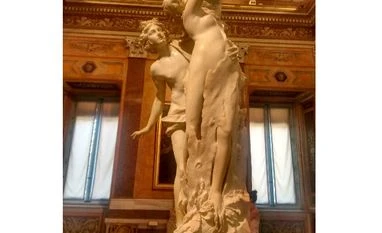
Equally arresting is the statue of Apollo and Daphne. Daphne is being pursued in a chase by a love sick Apollo. She runs out of strength and seeks help from her father, the river god, to change her form — the main culprit for her current predicament. He transforms her into a laurel tree, saving her from her pursuer. The transformation happens before your eyes as you see the lower half of her body harden into the bark of a tree.
But perhaps the most significant and moving of his works at the villa is the statue of David. This sculpture depicts the Biblical character, David, summoning his strength while aiming his slingshot at the giant, Goliath. David’s adversary is not sculpted in the piece but his stance and gaze suggest its presence, prompting the viewer to imagine the towering Goliath. As you take in the figure from various angles, you cannot help but feel thankful that David’s wrath is not aimed at you.
Villa Borghese
Once you have developed a taste for Bernini, keep your eyes and ears open as you wander in Rome for you never know where you will come across him again. Many of his works are to be found at churches, basilicas and piazzas around the city. At the Piazza Navona, for instance, the stunning fountain one sees is the work of Bernini. His head of Medussa — another famous work — is housed in the Musei Capitolini in Rome.
To describe Bernini’s sculptures as real-life is both an understatement and plain silly. If you thought you’d seen the best of what the world has to offer in terms of sculpture when you set your eyes upon Michelangelo’s Pietà at St Peter’s basilica, think again. Visit Galleria Borghese when in Rome and then decide.
ALSO READ: The Rome that was: Caesar and son 
 "Bernini: Breathing life into stone")


 Connect with us on WhatsApp