Korean car maker SsangYong’s ownership changed thrice in the 20 years since 1997 but its fortunes didn’t. The company, which got its fourth owner in Mahindra & Mahindra in 2010, finally appears to be emerging out of the woods.
SsangYong, which has in the past come out with bestsellers like the Musso and Korando (derived from “Korea can do it”), posted a profit of Rs 128 crore in the nine months ended September 2016, its first tryst with profits since 2007.
When M&M bought the bankrupt company with a strife-torn workforce for Rs 2,100 crore, many felt it would be an uphill task to bring it back to stable and profitable operations. After all, China’s biggest automaker, SAIC, had tried to revive SsangYong but had given up after five years. There was strong opposition from the workers’ union at the Korean company, which wasn’t convinced that M&M would be able to turn around the company. It also saw M&M as a producer of low-cost vehicles which had acquired SsangYong only to extract technology.
Years of instability at SsangYong had indeed turned many sceptical. In 1998, SsangYong was merged with another Korean company, Daewoo, one of the chaebols. However, in a couple of years, high debt crushed Daewoo and creditors took control of SsangYong. SAIC bought a 48.9 per cent stake in the company from the creditors in 2004 but gave up in 2009, after which SsangYong filed for bankruptcy.
What prompted M&M to do this acquisition? M&M Managing Director Pawan Goenka says the biggest factor was that SsangYong was an SUV specialist like M&M. “With the brand positioned at a slight premium to Mahindra, this partnership could facilitate significant synergies in platform and aggregate sharing, joint product development, sourcing, distribution and so on. In addition, SsangYong was based in a well-developed and sophisticated automotive eco-system: South Korea.”
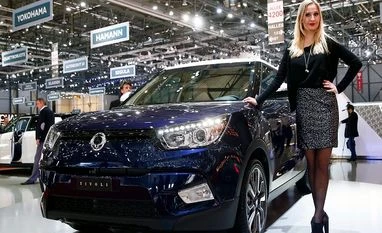
The bet seems to have paid off. The Tivoli, a sports utility vehicle the company launched in January 2015, has emerged as the bestselling vehicle in its 62-year history. A total of 63,693 Tivolis were sold in 2015, breaking the record held by the Rexton which had sold 54,274 units in 2004. The Tivoli broke its own record in 2016 by selling 85,821 units. In fact, it sells more than any SUV that M&M, its parent, sells in India. The Bolero, M&M’s bestseller, does average monthly volumes of 4,200, which translates into annualised sales of around 50,000.
A new focus More could follow. A year ago, Goenka had said there would be an investment of $1 billion to develop new products at SsangYong over the next three to four years.
Goenka, also the chairman of SsangYong, says the focus post-acquisition has been to invest in new products, brands and market development, cost reduction and the ability to extract synergies with M&M in various aspects such as platform sharing, sourcing of raw material and components and R&D.
“There are meaningful synergies which both SsangYong and M&M have benefited from. As would be expected, these are primarily in the core areas of products, platforms, aggregates (engines and transmissions), sourcing, and technology development,” says Goenka.
He is pleasantly surprised on the synergy opportunities that the two companies were able to identify in areas such as IT, human resources management, and the sharing of best practices across the entire suite of organisational activities.
M&M and SsangYong both have benefited from the improved bargaining power from component suppliers. Some Indian suppliers of M&M have started supplying components to the Korean subsidiary, while M&M has begun sourcing some parts from SsangYong’s suppliers.
SsangYong, which used to export more vehicles than it sold in South Korea for years, saw a trend reversal last year when its domestic market became bigger. Exports had taken a beating due to currency challenges in its key market, Russia, where a weakening local currency reduced the demand for imported vehicles. In early 2015, the company suspended exports to Russia. Consequently, the focus on the domestic market increased.
M&M also aspired to introduce premium SUVs from its Korean subsidiary into the Indian market. That was done with much fanfare but it failed to generate enough volumes and the company therefore did not launch the Tivoli in the Indian market. M&M continues to sell the Rexton (under the SsangYong brand) in India but its sales are abysmal: less than one a day. M&M is now developing an SUV for the Indian market on the Tivoli platform.
Moving ahead, M&M will see some challenges in further improving the performance at SsangYong. “There are challenges and opportunities. The main challenge is managing the foreign exchange risk in the current volatile macro-environment, building a distinctive brand and maintaining competitiveness. We have made significant headway in all these areas,” states Goenka.
The company has started focusing on new overseas markets such as the UK, Europe and Iran that are now becoming significant contributors to SsangYong’s export volumes.
The turnaround of SsangYong also means that it is now a bigger entity in the M&M fold. During FY12 (the first full year under M&M), SsangYong accounted for 19 per cent of the SUV major’s consolidated revenue. This has now climbed to 24 per cent, even as overall revenue has expanded. SsangYong has also become bigger in its domestic market: it used to have a 12 per cent share in segments where it operates during 2011 and moved up to 17 per cent last year.
In bringing SsangYong to a stronger footing, M&M joins the short list of Indian automotive companies that have managed to acquire under-performing assets overseas and bring efficiency and improvement. The turnaround of Jaguar-Land Rover under Tata Motors is the biggest-known example. Bajaj Auto acquired the loss making Austrian motorcycle maker KTM in 2007. In 2015, KTM globally sold a record 183,170 units and also posted a highest turnover of ^ 1 billion.

 "How M&M turned SsangYong into an asset")












 Connect with us on WhatsApp