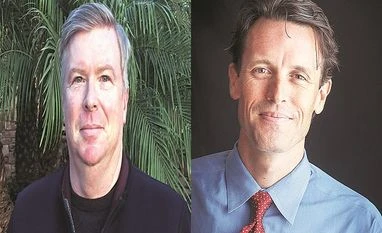
Interview with Brandon Black & Shayne Hughes Authors, Ego Free Leadsership
According to you, ego is a constant preoccupation of our self-worth. And it’s a predicable system where trigger reactions can be mapped. What are the ways in which leaders can map and control their trigger reactions?
Black: In any situation — team meeting, board presentation, performance review — a large part of our brain is distracted by an inner voice of judgement. Will I be good enough? Valued? Competent? How are my boss and colleagues judging me? Is this worth my time? This is our ego’s preoccupation with self-worth.
Many people experience this as anxiety, while others use it as a drive to succeed — to prove that they are smart, competent, wise, the “go to” person. This is our “offensive” ego.
Each time we experience this emotional rush, it seems real and specific to that situation. It’s neither. We have two to four primary ways we obsess about our value (incompetent, stupid, weak), and we project them constantly into our lives. These feelings drive unhelpful behaviours.
One key strategy for dealing with these emotions is to observe and document our “mind chatter”. When we react negatively to an event, we need to stop and capture how our sense of value was threatened. Over time, you will notice themes. You can also learn to pre-empt your reactions. When headed into a challenging conversation or meeting, identify your fears and goals. Share these feelings openly with the other participants, and you will find this vulnerability will set the tone for others to show up authentically.
Culture change is a long and exhaustive process in any organisation? In what ways can a leader accelerate the process of changing the mindset of executives?
Hughes: We have all heard the adage, change starts at the top. Despite knowing that, many leaders place the burden of change on employees and not themselves. Executives too often declare, without modelling, the changes they want to see. This is viewed by employees as hypocritical, causing people to become cynical and reject the call for change.
To lead culture change, leaders must openly discuss their weaknesses and how they contribute to unwanted cultural tendencies. Counter-intuitively, your greatest opportunity as a leader is when you “fall off the bicycle”. Openly recognising your counterproductive behaviour and asking for support sends a message that you’re committed, and it is safe to learn and be on the path of your cultural aspirations. Others will follow.
Next, executives must build processes to identify where change is taking root and where it is being rejected. A confidential employee survey with questions specific to the desired culture change will illuminate the differences. The data gleaned from the survey can help target interventions and allow for celebrations in groups where there is positive movement.
You suggest that a lot of organisations fear dysfunction and misalignment because of the way they manage performance. Could you illustrate this with an example and corrective measures that can help fix this issue?
Black: Today’s complex, matrixed organisations require leaders who trust, collaborate and see the big picture (beyond their silo or team). Unfortunately, many performance management systems directly undermine these.
Leaders are typically measured on both their individual and team’s specific performance objectives: A salesperson on sales, a production person on output and uptime, and a quality control person on number of misses. Often, these priorities are in conflict with each other. Each side’s fixation on how their performance will be managed distracts it from the company’s true goal of having high output and quality.
It doesn’t have to be this way. Executives can establish compensation frameworks that reward all employees based on the overall results of the company instead of group-by-group. Payouts can vary at the individual/group level, but the targets need to be consistent. In addition, goals must be viewed as dynamic, with an alignment to the most important corporate goals. They can’t be established at the beginning of the year and go unchanged until the next year. Business is changing constantly, so should the organisation’s goals.