The three men in the room have been trying since 2014 to infuse a seven-inch-tall robot with something that takes human beings a lifetime to learn — emotional intelligence. Their own belief systems may have a less-definite location but these co-founders of a startup named Emotix will soon market a companion droid that has a moral centre. “Let’s put it this way,” says CEO Sneh Vaswani, “the director of the movie may not necessarily be a good actor.”
That is perhaps a line he has used before to explain the fledgling project. Although the Emotix bot is part of the heavily-futuristic ‘artificial intelligence’ space, it has elementary ambitions for now. Miko — short for ‘My Companion’ — aims to entertain and educate children upwards of age five, most likely from well-heeled homes of urban areas. It will answer questions, tell stories, play games, and offer advice to young users. The company pitches it as a “personal buddy and developmental aid in a puppy-sized package.”
It is interesting that the Emotix core team, which unsurprisingly had roots in the Indian Institute of Technology-Bombay, chose to make a toy for kids. Its members are all under 28, and have zero experience in parenting. But market research told them that young users are typically “quicker to adopt technology.”
This adeptness with gadgets, the company found, causes fears about potential smartphone addiction in 92 per cent of parents polled. Vaswani first noted such concerns during a corporate stint in Bengaluru, when his roommate’s visiting relatives kept reprimanding their child for using the phone. He quit that job in 2014 and contacted IIT-B mates Prashant Iyengar and Chintan Raikar, with whom he had previously built autonomous underwater vehicles for competitions.
The team worked out of Vaswani’s home in the beginning, then moved to a room in his father’s office in Wadala, before renting an office in Parel. Seated in the meeting room of this new space, they list more insights that convinced them to make a robotic companion for young boys and girls; for instance, 70 per cent of Indian families are nuclear, and 80 per cent of parents they polled are reluctant to take away phones since technology exposure is needed to stay competitive.
Miko does seem to have a mind of its own. When co-founder Iyengar sets it down on the smooth brown conference table and says “Hello”, it begins to slide and revolve before replying with a prolonged “Hi”. Its form is somewhat like a baby bird, only significantly larger. On either side are circular rims which light up. Miko’s face is a screen, with digital dots for eyes that turn into half moons when sharing chirpy commentary. “I would love to show you what I can do. I can do so much it will blow your mind.”
There is a pause after a question is asked, when it searches its database for answers. “Lotus. Lotus is the national flower of India,” it responds in staccato, with an outer-space voice. The accent leans towards the American. The screen relays pictures while playing any of the three inbuilt-games, or songs. Miko’s intelligence comes through when it seeks a break by telling a fib: “Oh, it’s time I have to go do my hair.”
Although this was not evident in the short demo, Miko can seemingly learn about a child’s personality over a period. Parents have control of a dashboard where they may enter goals like “respect elders” or “eat more vegetables”. The robot will make it a point to bring these up in conversations. It can be programmed to avoid certain subjects too. The inherent “rights and wrongs” by which Miko abides are widely-accepted rather than nuanced, according to Vaswani. “No parent will want the child to cheat in a test so that is a given. But eating pizza may be alright with some parents and not with others, so we leave that out.” The team selected roughly 2,000 such virtues from various cultural texts.
While developing Miko, the techie team understood the value of creative expertise. “We were looking at everything in an analytical, mathematical framework,” observes co-founder Raikar. Linguists and child psychologists came in to apprise the team on the qualitative aspects of parent-child relations. “We went back to the drawing board, threw out two months of effort.” Among the discarded ideas was one of making a video game connected to several tiny robots that would encourage physical activity in kids. Another was the concept for a robot where a smartphone could be fitted as the screen.
The Emotix team has grown to about 22 people over time, including an ex-Apple designer from Korea and another from Kiev. The designers had a simple brief: make it child-safe but also very cute. Miko’s plastic exterior has rounded corners and colours that will purportedly appeal to both boys and girls. The company won’t disclose specifics but says this project is backed by “serial tech entrepreneurs” and professors in Silicon Valley and India.
A main challenge for Emotix has been the lack of precedence. Such a product never existed in India so it was not clear what might strike a chord. “Where do you put the barriers of innovation?” says Vaswani. “Deep technology takes years to evolve. But we didn’t want to be an R&D company that stays in a shell for five-six years and then finally comes one day saying this is the magic pill.” The company wants to gauge user reaction before planning upgrades.
Internationally, after the release of smart speakers like Google Home and Alexa, Mattel will bring out a smart baby speaker that can monitor, tell stories, sing, and answer questions. There could be a need for user distinction after a viral video last month showed how Alexa misunderstood a toddler’s command and offered to play explicit content. Vaswani says Miko is meant for kids over five years of age because their cognitive skills are unsuited before that.
The global market has several social robots with uniformly short names — Jibo, Nao, Kuri. These household companions are believed to be more effective than flat-screen devices in convincing users to stick to their diet or schedule. There is, however, scepticism over devices that can listen and watch in people’s homes. “Miko is not a spying device,” clarifies co-founder Iyengar. It will not log every single interaction for the parent to look at but highlight the important ones. Parents can also delete the database at any point.
But children are known to be fickle in their affections for toys. When it rolls out in February, Miko will have to work hard to keep them interested. At Rs 19,000 a piece, it is only slightly less expensive than Mattel’s Aristotle that will cost $300 (over Rs 20,000). If it attracts enough buyers, the company expects developers will come forward to build games and apps around the device.

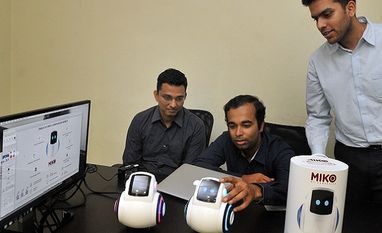 "Miko the robot: Meet your child's new companion")












 Connect with us on WhatsApp