West Asia in the age of Jihad

Journalist Patrick Cockburn provides an incisive & unsparing analysis of the region's conflict zones
Syria, conflict, violence
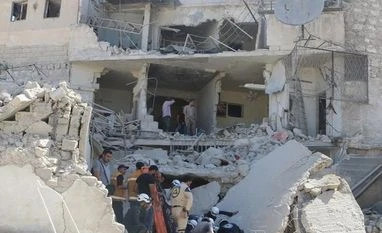
OFF THE WALL: Syria’s civil war involves government forces fighting a bizarre variety of rebel forces. (Photo: Reuters)
Talmiz Ahmad
Last Updated : Jan 13 2017 | 11:44 PM IST
Patrick Cockburn has been covering West Asia as a journalist for nearly 40 years and thus has personally witnessed the “chaos and conflict” that have characterised this region throughout this period. The book looks at the present-day conflict zones in West Asia— Afghanistan, Iraq, Syria, Yemen, Bahrain and Libya— and the early rise and successes of the Islamic State. 

Each section consists of a short introductory essay that places the conflict in context and then goes on to Cockburn’s contemporary notes on the various developments that shaped the emerging conflict, as viewed by him at the time. The book is embellished with an excellent introduction and an afterword.

There are three principal players that are today shaping the West Asia narrative: the authoritarian rulers, mainly from the sheikhdoms; the foreign powers intervening politically and militarily in the region’s affairs, and the cruel and vicious militants that are motivated by deep-seated sectarian animosities, but who often enjoy the support of regional state powers.

The author has come to some sobering conclusions: that western interventions have generally been based on extraordinary arrogance coupled with wishful thinking bordering on jingoism and deep ignorance of the region’s history and developments in their operational areas; that much that went badly wrong in the region could have been predicted if the intervening powers had not been so consumed by hubris, and that, amidst the murder and mayhem, there are neither “good” nor “bad” guys, nor have there been clear winners or losers.

Starting point: Afghanistan
 
The modern-day narrative of West Asia begins with the “global jihad” in Afghanistan, sponsored by three state powers, the US, Saudi Arabia and Pakistan, for short-term advantage. But, they spawned the world’s first and lethal transnational jihadi movement, whose depredations affected each of its sponsors, culminating in the attacks of 9/11. 

In retaliation for 9/11, the US launched its assault upon Al Qaeda and Taliban in Afghanistan, but failed to deliver a fatal blow on them as the rank-and-file melted into the population, while the leaders were given sanctuary in Pakistan. The US also failed to read the politics right when it worked closely with the warlords, who were detested by the ordinary Afghans, and then installed the Karzai government in Kabul: Cockburn noted in 2008 that “the dominant political feature was dislike or hatred of the [Karzai] government at all levels of society”.

The other glaring US failure was not to confront Pakistan’s sustained sponsorship of the Taliban which, Cockburn says, “was central to the Taliban’s ability to train, recruit and re-supply its forces”. The author notes that the Obama administration was told that “the heart of the military problems facing the US in Afghanistan lay in Pakistan”, but the US just could not handle Pakistan effectively. 

Today, Western forces have withdrawn, the Taliban, backed by Pakistan, control much of the country, and Afghanistan remains in civil conflict.

Book Price: $29.95
Fratricidal conflicts
 
The US occupation of Iraq from 2003 led to nation-wide resistance through guerrilla attacks and suicide bombings, even as US presence was tainted by the abuses of Abu Ghraib and its policies fomented conflict between the Shia, Sunni and Kurd. In October 2006, Cockburn noted that “the US and Britain have largely provoked the civil war that is raging across central Iraq”.

Cockburn describes the steady coarsening of the Iraqi political culture during the occupation, the rampant corruption and nepotism of the ruling elite, and the deepening sectarian divide, all of which facilitated the rise and rapid expansion of the Islamic State, a religious and social utopia characterised by beheadings, amputations, floggings, crucifixions and public executions.

Cockburn gives a detailed account of the systematic destruction of Libya resulting from Western and Arab interventions. His story begins with the neo-imperial posturing of Western leaders supposedly promoting democracy and ends with the “Somalianisation” of Libya — a permanent state of chaos and warfare.

Other “Arab Spring” countries have fared no better: Bahrain is in the throes of deep sectarian hatred, accompanied by state-sponsored demographic changes to favour the Sunnis, widespread human rights abuses, and increasing extremist influence among the security forces. 

Syria is going through catastrophic civil conflicts that sees government forces fighting a wide variety of rebel forces which today, Cockburn says, “have become wholly dominated by ISIS and Al Qaeda clones”, with a major supportive role being played by the sheikhdoms. 

Yemen is embroiled in a vicious sectarian conflict for the first time in its thousand-year history, largely sponsored by Saudi Arabia that sees Yemen as an Iranian outpost and hence a front in the proxy confrontations it has set up against Iran across West Asia.

West Asian quagmire

At the end, Cockburn sees a parallel between the present situation in West Asia and the end of Ottoman rule a hundred years ago, which was characterised by “murder and migration of whole groups”. Today, religious and ethnic minorities in this region, Sunni, Shia, Alawites, Yazidis, Druze and Christians, find themselves in grave jeopardy. “Life has never been so dangerous and uncertain” for the people of West Asia, Cockburn reminds us. 

The book is an excellent compendium of Cockburn’s writings that are invariably clear, sharp, sensible and unsparing in assigning blame where it is due. But, the absence of a continuous narrative could put off general readers: Iraq, for instance, figures in two parts, at pages 33-182, and then again from page 311 onwards. Similarly, Afghanistan is covered in two parts — the first part ending on page 31, and the second part starting on page 183.

Linked with this is the second problem with the book: it lacks an integrated vision that would have shaped a more coherent account. But, this is compensated for by the freshness and spontaneity of contemporary developments being observed and analysed as they take place: here, Cockburn’s insights are unrivalled and a treasure trove for the scholar.
The reviewer is a former diplomat

One subscription. Two world-class reads.

Already subscribed? Log in

Subscribe to read the full story →
*Subscribe to Business Standard digital and get complimentary access to The New York Times

Smart Quarterly

₹900

3 Months

₹300/Month

SAVE 25%

Smart Essential

₹2,700

1 Year

₹225/Month

SAVE 46%
*Complimentary New York Times access for the 2nd year will be given after 12 months

Super Saver

₹3,900

2 Years

₹162/Month

Subscribe

Renews automatically, cancel anytime

Here’s what’s included in our digital subscription plans

Exclusive premium stories online

  • Over 30 premium stories daily, handpicked by our editors

Complimentary Access to The New York Times

  • News, Games, Cooking, Audio, Wirecutter & The Athletic

Business Standard Epaper

  • Digital replica of our daily newspaper — with options to read, save, and share

Curated Newsletters

  • Insights on markets, finance, politics, tech, and more delivered to your inbox

Market Analysis & Investment Insights

  • In-depth market analysis & insights with access to The Smart Investor

Archives

  • Repository of articles and publications dating back to 1997

Ad-free Reading

  • Uninterrupted reading experience with no advertisements

Seamless Access Across All Devices

  • Access Business Standard across devices — mobile, tablet, or PC, via web or app

Next Story



