One of the oldest luxury brands and for a long time, the only one, to ply Indian roads, Mercedes Benz is stepping on the gas. With a larger number of models and an expanded network of dealers, the company is fighting off rivals BMW and Audi to get back its pole position. It has also renewed its customer engagement initiatives through a slew of measures that reach out to the premium buyer as well as the luxury brand enthusiast among the young. As a result the brand jumped from 133 to 14 in a list of brands ranked according trust by global research advisory TRA earlier this month and has recorded its best ever quarter in terms of sales volumes in January-March 2016.
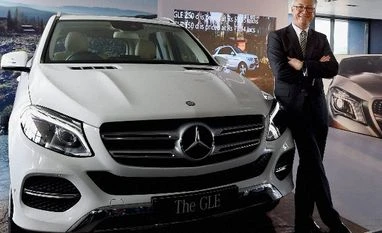
Competition is good for any brand and a competitive environment brings out the strength of a strong brand, says Roland Folger, managing director and CEO Mercedes-Benz India.
For a long time Mercedes was the sole claimant to the luxury tag in the Indian auto market. In 2009, it was displaced by BMW and two years later, it dropped to third place after Audi took the first spot. This served as a wake-up call and the company decided to examine its brand strategy in the country. The result says Folger is a company that has decided to focus on feature-rich models, an expanded dealer list and a large product portfolio that caters to different categories of customers. It has also meant reaching out to buyers who believed a luxury brand was out of their league.
The strategy seems to have paid off. Mercedes Benz overtook Audi in India in 2015 when it sold 13,502 vehicles (growing 32 per cent over 2014). And in 2016, the company says it has recorded its best fiscal year (13,558 units) and has sold 9,924 units during January-September 2016. Audi and BMW have not yet announced sales data for the year. The January-September volumes are lower by 1.5 per cent against the corresponding period of 2015, however. Mercedes says that this is due to the uncertainty around diesel vehicles and levies on luxury cars and it would be happy achieving last year’s numbers and at best growing slightly more than 2015, which was a year of significant growth.
Folger believes that the brand has come back stronger than ever. Apart from providing customers with a wider range of models and a wider network of dealers, ease of financing and high servicing standards are pulling buyers in too. “Automobile business requires long-term vision, a sharp and focused long-term approach to the market. Only then you can create trust in the brand. We are able to earn that trust and that is what separates us from others,” he adds.
Changing the line-up
When the company started out in India, it pursued what it calls a ‘top of the pyramid’ product strategy. It focused on premium, feature-rich cars meant for the super-rich. Over the past couple of years, the product line-up has been expanded to include a wider range of models across different price points. The A-Class Benz has changed the brand perception of Mercedes-Benz and got immediate attention of young buyers says Folger. "We have a Mercedes for every segment. We have a young, diverse and top-end product line-up," he says.
In 2016, the company launched 11 new products and it says that it is not yet done. Having more cars in the portfolio means it can reach out to buyers in different price categories. Last week, it launched two new convertibles, priced (ex-showroom, Delhi) at Rs 60 lakh and Rs 2.25 crore, respectively, for instance. With this the company hopes to net a wider set of customers than its competitors.
The company says that it has the largest luxury car network in India today with 86 outlets across 41 Indian cities. "This has been a key pillar to our success,” says Folger. He believes that the company has managed to tap into a latent demand for luxury cars outside the big metros where owning a luxury car is no longer taboo.
Customer engagement
The company has focused keenly on its communication and branding functions over the past few years. Its traditional customer base includes businessmen, CEOs and company chairmen and many promotional activities were tailored to meet the needs of this community. An experiential branding initiative called ‘LuxeDrive’, for instance, where buyers are treated to a luxurious spread of food and entertainment has been a big hit. In small towns the initiative has helped convince many buyers to upgrade to a luxury brand, the company says.
The aim is to keep the brand talking to customers across the age and price spectrum. For that the brand has upped the ante on digital media. The MD and CEO engages with potential customers, fans and enthusiasts online through an initiative called ‘MB Dialogue’, which has helped the brand find a whole new set of customers.
The company says that over the past few years, more women customers have opted for a Mercedes-Benz. They make up close to 12 per cent of company's customer base today. Similarly although key metros of Delhi and Mumbai contribute about 45 per cent of the company’s national volumes, smaller metros, Tier I and II markets are big contributors as well. “This is in-line with the India growth story, where smaller cities are considered to be the engines of the next phase of economic growth,” Folger says.

 "Mending it like Mercedes")


 Connect with us on WhatsApp