The old British Indian empire of our schooldays consisted of India, Burma and Ceylon (Pakistan and its progeny, Bangladesh, were still to be born then). Known as Burma to my generation rather than Myanmar, we knew of that country as the source of two key commodities — petroleum and rice. During the World War II years when rice was rationed, we considered Burma rice to be a premium product. The Chettiars of Tamil Nadu had established flourishing trading operations between South India and Burma and that was how rice came to India. The only other contact was through Burmese students, like Delhi’s celebrated pupil Aung San Suu Kyi, who used to come to study in Indian cities. But due to the strict embargo by the Burmese military dictatorship on travel and international contacts with the country and its people, very little is known in India about that enigmatic land.
Recently, I spent a couple of weeks in Myanmar. From Mumbai, one can fly by Thai Airways to Bangkok and then on to the capital city of Yangon, the famed Rangoon of yesteryears. It is a six-hour flight, and once you reach there, there is no big difficulty in communication since English is spoken and understood by staff of airlines and hotels. One only has to adjust to the nasal pronunciation, typical of the Chinese with whom the Burmese people are racially interlinked.
For an Indian, the most striking thing about Myanmar is the prevalence of Gautam Buddha and his teachings in the country’s everyday life. Everywhere you turn, you will see Buddhist monks and monasteries. In Yangon, there is a 300-feet-long granite figure of a reclining Buddha beside a hotel. A few hours’ drive slightly north of Yangon is Bago, where there are several monasteries. On the day I was visiting Bago, there was a gathering of about 500 people to witness the prize-giving ceremony for schoolgirls who had participated in a nationwide competition on reciting the Buddhist sacred texts. Everyone was seated on the floor facing a large statue of the Buddha. At a given point, the girls recited the prayers read out to them by the priest. For me it was almost as if I was in a Christian Church where the priest was conducting a devotional service through hymns. One could discern the sincerity and faith among these young ladies, all dressed in white, sitting reverentially on the floor with their legs crossed.
* * * *
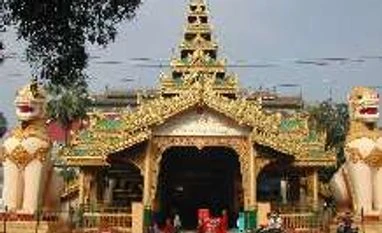
Bago-Shwethalyaung Building
It was a sight that reminded me of the old days in our church in Kerala where everyone sat on the floor, women and girls separately from the men. Even the songs of Myanmar had a harmony, not unlike that of Christian hymns.
The next day I flew north from Yangon to a place called Bagan which has over 3,300 Buddhist stupas. This collection of stupas is recognised as one of the wonders of the world. They were built by the kings of Burma between the 11th and 13th centuries to celebrate their victories in battles against other neighbouring tribes. Each stupa is an elaborate dome, the tallest measuring over 150 feet in height. The kings who built these impressive stupas were doing it to express their gratitude to the Buddha for their victories. So great was their wealth and power that to the ancient Burmese kings, a stupa may perhaps have been the equivalent of what an ordinary candle is to an average Catholic today.
Contrary to popular impressions, the Myanmarese are an extremely religious people. They prostrate themselves more than once when they are in front of a Buddha statue. In Baga, the Buddha’s face expresses benevolence, happiness and concern as you look at him from the three angles . In one of the stupas there, a part of the Buddha’s tooth is believed to be embedded.
Away from these, Mandalay reminded me of one of our own Indian cities like Bangalore. It is well laid out and the buildings and everything else are well maintained. One of the attractions in Mandalay is the kilometre-long bridge made entirely of teak wood, with no iron or steel components used in its making. This bridge spans a very large water body called Taungthaman Lake. It also has a monastery which houses around one thousand monks. The monks go out early in the morning to beg for food and return to the monastery before 11 am to have their only meal of the day before noon. They fast till the next morning.
* * * *
My guide throughout the tour was a young Myanmarese man named Tun Tun Win. He was well-educated, knowledgeable and helpful . He travelled with me from Yangon to Bago, Mawlamyine and Bagan, recalling to me the history and important features of each place and monastery we passed. By normal standards he is well paid. But tourism being a seasonal occupation, the young man does not earn throughout the year, so he has to take up other part-time jobs. He is about 32-years-old, yet feels that he cannot afford to get married like many other people in his country because he does not have a stable job. His knowledge about India is very limited because most of the time he interacts with tourists from Europe and the United States. Very few Indians make it to Myanmar. So despite the links to the British Empire, India is a relatively unknown country, although all Myanmarese know that the Buddha came from Gaya in India.
I feel that there exists a great opportunity for our government and tourist organisations to sell India as a holiday destination to the Myanmarese people. For example the appropriate Buddhist authority in India could institute a system whereby people who visit and stay at Bodh Gaya are given special concessions and a title in the manner of the Haji title for Muslims who go on a haj, or pilgrimage, to Mecca. Maybe something like “Buddha Dasa” could be considered. This may encourage more people from the neighbouring country to visit the Buddhist holy places in India. As that country is set on a cusp of economic prosperity, there could be an increasing potential for such religious tourism. One has only to look at the example of Rome or Varanasi, both of which attract religious tourists by the million. Gaya could become like them. The Koreans and Chinese too may find it an attractive religious tourist spot too. An ageing population in Asia could propel more people to visit Gaya because old age is when one feels the need to get closer to God.
Myanmar is a land of monks and monasteries with charming people and geographically close to India. I am sure many more Indians will find it a very interesting tourist destination. Both the countries have a common link in Buddhism, the Myanmarese as Buddhist faithfuls and Indians as citizens of the country where the Buddha was born and preached his teachings, which have influenced the history and culture of most of Asia.

 "In the land of the monk")


 Connect with us on WhatsApp