Every year, around this time, we plan investments and pay life insurance premiums so that we are up-to-date with our tax records. Paying for car insurance doesn't please us as much, but we ultimately write out the cheque, saying it's a necessary evil. But when it comes to "optional" car safety features, we hit the blind spot. We sell the idea to ourselves that leather upholstery and alloy wheels are must-haves, while airbags are an expensive proposition and replacing them after meeting with an accident will cost a small fortune. Unfortunately, the mantra to making saleable cars in India is to keep their price tags low. In the process, for the available price, companies offer bling rather than safety. An independent crash test report by Global NCAP (New Car Assessment Programme) recently revealed that five of India's most popular cars - Maruti Suzuki Alto 800, Tata Nano, Ford Figo, Hyundai i10 and the Volkswagen Polo - come with a high risk of life-threatening injuries in road crashes. We take a look at safety features that can make a difference between life and death.
Airbags: These inflatables provide additional protection in case of an accident. But keep in mind that one still needs to wear a seat belt at all times even if the car has airbags. During a head-on collision, the seat belt restrains your body from moving forward and hitting the dashboard. Airbags deploy and cushion the body from a fatal blow. However, deployed airbags can also cause chest injuries, concussions and whiplash injuries. Therefore, it is advised that children under 12 years should sit in back. The lack of airbags in basic models of Indian cars were mostly to blame for the poor show at Global NCAP and they are now making amends. To meet international standards, Volkswagen India has now shelved its non-airbagged Polo variants. Arvind Saxena, managing director, Volkswagen Group Sales India, claims, "With the recent introduction of dual front airbags as standard fitment on all variants of the Polo in India, the car is now the safest premium-segment hatchback in the country." David Ward, secretary general of Global NCAP, responds, "It is encouraging to see that fitted with two airbags as standard, the Polo now adults four-star protection."
Stable structure: A cabin can withstand severe impacts if there are adequate crumple zones on the bonnet or the boot. Crumple zones are designated spots on the car's body that absorb the maximum of the forces exerted in a car crash. According to the NCAP report, Ford Figo was the only non-airbag car that was considered stable in terms of crumple zones, while the Volkswagen Polo was considered safe only after twin airbags were fitted to protect the driver and front passenger. Ford India says, "Safety is one of the highest priorities in the design of our vehicles. Ford Figo, with its inherent structural quality and strength, has been designed to meet existing local regulatory requirements." While the basic Alto and Nano proved to be unstable in case of an accident, it was surprising that the Hyundai i10, which is manufactured only in India and is considered one the safest hatchbacks in Europe, also failed the tests. However, not every vehicle can be condemned as unsafe even if it seems to have failed a test. As Datsun India head Vincent Cobee explains, "There is no such thing as a global standard on safety. If you step out of India and if you look at Japan, the United States and Europe, safety standards are completely different," he says. "Safety standards are the consequence of political, economic, technical and social factors and I don't see any reason why, for instance, western standards should be applied to India without further discussion."
Anti-lock braking system (ABS): In a vast country like India with contrasting weather conditions, cars have a tough time adjusting to road conditions and braking can often become a serious challenge. Anti-lock brakes help drivers have better control of their vehicle in slippery conditions where they have to pump the brakes to make sure the wheels don't lock. If they do, the car can spin out of control. A sensor keeps a check on each wheel's activity and regulates brake pressure so that all wheels operate in a similar speed range. But unfortunately everything comes down to costs and a vehicle with ABS is significantly costlier, making buyers in a price-conscious market like India shun the safety feature as just another pricey addition.
Electronic Stability Control (ESC): The risk of skidding is high in wet or icy conditions, and it becomes more difficult for drivers to keep the vehicle steady if the car skids laterally. This happens when front wheels tend to understeer while rear wheels oversteer. This is where ESC comes in. The system applies individual brakes and helps bring the car safely back on track. So is there a difference between ABS and ESC? Well, every car with ESC has ABS and Traction Control, but not necessarily the other way round. ABS and Traction Control are effective in a straight-line skid, but ESC is a more complete system and ensures the car is stable when it slides sideways. Again this technology is very expensive and jacks up a car's price considerably.

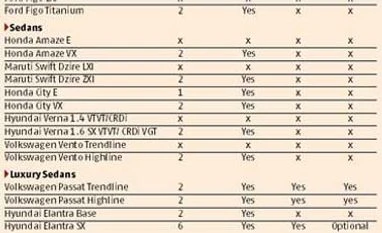 "Blind-sided")


 Connect with us on WhatsApp