At a time when clean, unpolluted air and clear sunshine are at a premium in north India, there is a region that has them both in plenty - but has still been struggling with a unique set of problems. Lahaul and Spiti in Himachal Pradesh together form one of India's most underdeveloped regions, and their harsh climate, steep terrain and sheer inaccessibility make development efforts that much harder. But there is one organisation that has been developing inexpensive renewable energy innovations in the region since 2002, and has used the power of the sun to make a difference to countless lives. Meet Ecosphere Spiti, a group that has used principles of solar passive architecture as a starting point for its multi-pronged development efforts in the region.
"When we started working here, we realised that Spiti urgently needed development, but at the same time, we could see how it's vulnerable ecology was being adversely affected by the development that was taking place," says Ishita Khanna, founder of Ecosphere Spiti. Their plans for sustainable development in the region became hinged on harnessing the region's ample sunlight and enabling rural livelihoods through village homestays. "We decided to use solar passive architecture techniques to modify existing houses (and build new ones) to reduce their traditional dependence on dung, coal and wood," she says.
Solar passive architecture uses double-glazed windows and insulated floors and walls to trap the sun's heat in the winter. Simply by installing south-facing, direct solar gain windows in Spitian homes, this technology ensures that even when it is minus 20 degrees outside, the inside temperature is as high as eight degrees without artificial heating. On average, a passive solar room reduces a household's fuel wood consumption to half, leading to savings of Rs 10,000-20,000, depending on family size. Moreover, it's a cleaner technology, leaving a small footprint on the region's fragile ecology. "Using similar principles, we also developed solar greenhouses - polythene-covered structures on wooden frames with a ventilator and door, in which villagers can grow food even when it is snowing outside," says Khanna. This ensures that villagers have a supply of spinach, coriander, onions and garlic - not just to consume, but also to sell.
Both these solar technologies make a perceptible improvement in the local quality of life, and cost relatively little to implement. "While a solar passive house costs less than Rs 50,000 to construct, a greenhouse can be made for about Rs 30,000," says Khanna. This year alone, Spiti Ecosphere has constructed 25 solar passive houses and 10 greenhouses.
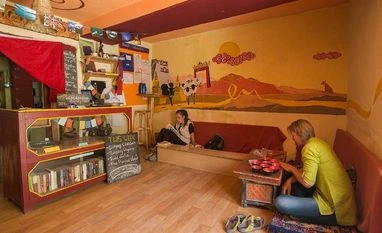
Incredibly, Ecosphere Spiti does all this without relying on outside funding. Instead, it uses its tourism activities to subsidise its development programmes. Using purely local expertise, it runs a restaurant, cafe and B&B in Kaza, and organises tours as well. "Last year, for example, we hosted as many as 50 groups of tourists," says Khanna. Ecosphere also has a variety of interesting travel-cum-volunteering options on offer. "Last year, volunteers helped us build an artificial glacier in the village Demul to recharge the ground water and worked on many of our greenhouse projects as well," says Khanna.
However, now Ecosphere Spiti needs funds and trained volunteers to expand their scope of activities. There are two new areas they want to focus on: health infrastructure and addressing the issue of growing water scarcity. "People in Spiti's remote villages don't have easy access even to first aid," says Khanna. This summer, Ecosphere volunteers found a little girl who'd had a bad fall and was severely hurt and bleeding. In the absence of primary healthcare facilities in her village, she would've had to undergo a bumpy two-hour ride to the hospital in Kaza for treatment. "Our volunteers administered first aid and made us realise that in many of these villages, first aid training could actually mean the difference between life and death," she says. Now, Ecosphere plans to conduct first aid training workshops in several villages, and is looking for trained volunteers to help them with this.
The water scarcity problem is due to climate change, because of which it has not been snowing as much as it earlier did in Spiti. "Without the melting snow to recharge the springs, people in mountain-top villages are being forced to walk all the way downhill to collect even drinking water. That is why the folks at Ecosphere are studying cost-effective solar water pumping technologies to see what best would work in Spiti's unique terrain.
The beauty of Ecosphere's projects is that it provides a replicable blueprint of sustainable development projects in ecologically fragile regions. Moreover, they underscore the urgent need to balance development goals with maintaining the sanctity of the environment, something that is often ignored but is of paramount importance in the present-day context, when the air we breathe has become toxic. As Spiti gears down to hibernate through its unforgiving winter, the Ecosphere model can open the country's eyes to the fact that harnessing the sun is a cleaner, greener and altogether more sustainable energy-generation option, compared to burning coal.
For more, visit
www.spitiecosphere.com or their Facebook page
Next up, an NGO has been conducting short-term camps to successfully improve the learning outcomes of first-generation primary school learners across India

 "Sunny days")


 Connect with us on WhatsApp