Home / Sports / Other Sports News / Hockey World Cup 2018: All you need to know about new competition format
Hockey World Cup 2018: All you need to know about new competition format
The Odisha Hockey Men's World Cup Bhubaneswar 2018 event will feature four pools comprising of four participating teams followed by a knock-out phase
premium
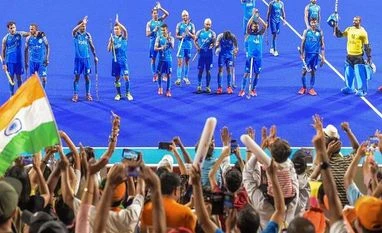
Indian men's hockey players celebrate with supporters on winning the bronze medal after defeating Pakistan 2-1 at the 18th Asian Games 2018, in Jakarta. Photo: PTI
The state capital of Odisha, Bhubaneswar, to host the 14th edition of the FIH Men’s Hockey World Cup 2018 from November 28 to December 16 at Kalinga Stadium. This time the Hockey World Cup will be played in a new format which would give every participating team a fair chance to excel in the Hockey extravaganza.
The Odisha Hockey Men’s World Cup Bhubaneswar 2018 event will feature four pools comprising of four participating teams followed by a knock-out phase. The number of teams that compete in the FIH Men’s World Cup has changed at various points in history. This year’s edition contains 16 nations, matching that of the 2002 competition in Kuala Lumpur, Malaysia. The 1971 competition in Barcelona (Spain) featured ten nations while the 1978 event in Buenos Aires (Argentina) was a 14-nation tournament. All other World Cup competitions have been 12 nation events.
The Hockey World Cup 2018 will see cross-over matches played after a pool stage. The cross-over matches will be played between 2nd and 3rd placed teams of each group and the winners of cross-overs will join the pool toppers in Quarterfinals.
Here all you need to know about FIH Men’s Hockey World Cup format:
4 pools of 4 teams each
Winners of each pool qualify for Quarter Finals
Last-placed team in each Pool eliminated
Crossovers between 2nd and 3rd in each of the Pools to determine the other four quarter-final teams.
Losers of crossovers eliminated
Losers of Quarter-Finals eliminated
Semi-Finals and medal matches then take place
Ranking of eliminated teams based on their performance at the time of elimination
The cross-over matches will be as follows
Match 1: 2nd Pool A vs 3rd Pool B
Match 2: 2nd Pool B vs 3rd Pool A
Match 3: 2nd Pool C vs 3rd Pool D
Match 4: 2nd Pool D vs 3rd Pool C
The winners of these matches will play in the quarter-finals, with the losing teams being eliminated. The quarter-finals will be as follows:
Match 5: 1st Pool A vs Winner Match 2
Match 6: 1st Pool D vs Winner Match 3
Match 7: 1st Pool B vs Winner Match 1
Match 8: 1st Pool C vs Winner Match 4
Read this article for free
Register to continue reading premium journalism and analysis from Business Standard.

 "Hockey World Cup 2018: All you need to know about new competition format")











