Building nanochips to address healthcare and environmental hazards

Infosys prize winner Navakanta Bhat's gas sensors are used by Isro to detect the minutest of leakages; his biosensors are much cheaper than conventional blood tests
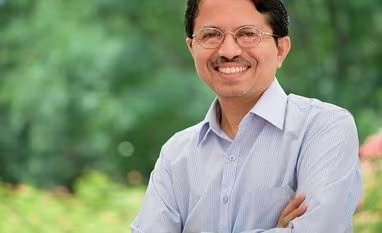
Navakanta Bhat
Infosys prize winner and head, Centre for Nano Science and Engineering (CeNSE) at the Indian Institute of Science, Navakanta Bhat
Samreen Ahmad Bengaluru
Last Updated : Jan 15 2019 | 12:48 PM IST
Despite the advancement in battery technologies, most mobile smartphones need to be charged at least once a day. Besides, they guzzle even more battery when connected to the internet, for which they are primarily being used nowadays. Many a times we wonder why our smartphones can’t run for a week or even more without charging. It’s very much possible, says Professor Navakanta Bhat, who heads the Centre for Nano Science and Engineering (CeNSE) at the Indian Institute of Science in Bengaluru. Bhat and his team are now spearheading a project to miniaturise the chips used in smartphones so as to increase their functionalities, including battery power, and reduce costs.

The Rustum Choksi award winner's expertise, however, is not just limited to electronic gadgets. He and his team have also built biosensors and gas sensors using these microelectronics which can get mass application in the healthcare and environment space. These are the innovations for which Bhat was awarded with Infosys Prize 2018 earlier this month, in the engineering and computer science category. 

It has been an over 40-year long journey for Bhat to reach where he is today. His love for electronics grew in a small town in Belgaum district of Karnataka in mid-70s, where his civil engineer father was posted. “Radio was the only gadget accessible to us which brought us real time information about the world,” says Bhat. It is this radio which kindled his interest in electronics and prompted him to choose engineering, as it would allow him to build gadgets that impact society. 

The journey that started in Belgaum, took him to Mysuru for engineering and later to IIT-Bombay and Stanford University for Masters and PhD, respectively. After Stanford, he joined Motorola's R&D lab in Texas in 1996, and started working on microprocessors which were then used in Apple computers. Around this time, he also started thinking about contributing in his own way towards building the chip manufacturing ecosystem in India. In 1999, he returned to the country to lay the foundation of CeNSE, which has now spread the scope of electronics research into areas like healthcare, environment and energy. Bhat and the team of researchers at CeNSE have developed biosensors to address healthcare issues, and gas sensors for multiple applications. 

The first gas sensors were built for the Indian Space Research Organization. Isro stores rocket fuel in huge containers and any kind of leakage could be hazardous. The sensors, the organisation was using were mostly imported. While one of the major drawbacks of these sensors was that they could not be easily customized, they were also not sensitive enough to detect minute leakages.

“Our low cost gas sensors can detect the minutest of leakages, including parts per billion. The gadgets built on nanotechnology have been successfully field-tested. Isro is going to phase out all the old sensors in a year or so, and use the ones we have developed,” says Bhat, who has authored or co-authored more than 250 publications and has 24 patents to his credit.

Along similar lines, Bhat has also been building air quality detectors for indoor and outdoor pollution. The gadget detects pollutants such as carbon dioxide, carbon monoxide, sulphur dioxide, nitrogen dioxide. His team is now doing field tests in association with pollution boards and the Karnataka government so that these devices can be set up at every traffic intersection and air quality can be checked real time. 

“The way Google Maps indicates the traffic on the route, our endeavour is to show the air contaminants along the route,” says Bhat. The device will be commercialised in a year or two. A couple of his students at IISc are also keen to launch a start-up for gas sensors. 

In the healthcare space, Bhat has developed biosensors to detect blood and urine markers including haemoglobin in blood and creatinine in urine. The device which utilises these sensors has already been commercialised through a start-up, PathShodh. Based on sensing chemistry, the device AnuPath can carry out five types of blood tests and three urine tests related to diabetes, kidney malfunction, anaemia and malnutrition. It is basically a lab on a palm. 

“The device, which costs around Rs 50,000, can carry out blood and urine tests at a cost 80 per cent lower when compared with the pathology labs,” claims Vinay Kumar, Bhat’s student and CEO of AnuPath.

Bhat would next be foraying into breath analysis to detect diseases. "Today, we diagnose disease by doing blood and urine tests. Our exhaled breath has over 1,000 gases and, depending on the increase or decrease in the level of certain gases, it can indicate different illnesses," says Bhat. “So if we can build a disease diagnostic device using breath analysis, which will be completely non-invasive, unlike blood tests, it would be a breakthrough in the healthcare space.” 

One subscription. Two world-class reads.

Already subscribed? Log in

Subscribe to read the full story →
*Subscribe to Business Standard digital and get complimentary access to The New York Times

Smart Quarterly

₹900

3 Months

₹300/Month

SAVE 25%

Smart Essential

₹2,700

1 Year

₹225/Month

SAVE 46%
*Complimentary New York Times access for the 2nd year will be given after 12 months

Super Saver

₹3,900

2 Years

₹162/Month

Subscribe

Renews automatically, cancel anytime

Here’s what’s included in our digital subscription plans

Exclusive premium stories online

  • Over 30 premium stories daily, handpicked by our editors

Complimentary Access to The New York Times

  • News, Games, Cooking, Audio, Wirecutter & The Athletic

Business Standard Epaper

  • Digital replica of our daily newspaper — with options to read, save, and share

Curated Newsletters

  • Insights on markets, finance, politics, tech, and more delivered to your inbox

Market Analysis & Investment Insights

  • In-depth market analysis & insights with access to The Smart Investor

Archives

  • Repository of articles and publications dating back to 1997

Ad-free Reading

  • Uninterrupted reading experience with no advertisements

Seamless Access Across All Devices

  • Access Business Standard across devices — mobile, tablet, or PC, via web or app

Next Story



