
Chandrayaan-I data confirms ice deposits on Moon's polar regions, says NASA
The ice deposits are patchily distributed and could possibly be ancient, according to the study
 "Chandrayaan-I data confirms ice deposits on Moon's polar regions, says NASA")
WebinarsNew
Deep DiveNew
Explore Business Standard
The ice deposits are patchily distributed and could possibly be ancient, according to the study
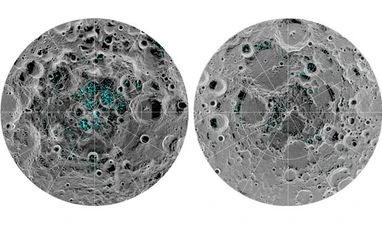
Scientists have found frozen water deposits in the darkest and coldest parts of the Moon's polar regions using data from the Chandrayaan-I spacecraft, that was launched by India 10 years ago, NASA said today.
With enough ice sitting at the surface -- within the top few millimetres -- water would possibly be accessible as a resource for future expeditions to explore and even stay on the Moon, and potentially easier to access than the water detected beneath the Moon's surface.
The ice deposits are patchily distributed and could possibly be ancient, according to the study published in the journal PNAS.
At the southern pole, most of the ice is concentrated at lunar craters, while the northern pole's ice is more widely, but sparsely spread.
Scientists used data from NASA's Moon Mineralogy Mapper (M3) instrument to identify three specific signatures that definitively prove there is water ice at the surface of the Moon.
M3, aboard the Chandrayaan-1 spacecraft, launched in 2008 by the Indian Space Research Organisation (ISRO), was uniquely equipped to confirm the presence of solid ice on the Moon.
It collected data that not only picked up the reflective properties we would expect from ice, but was able to directly measure the distinctive way its molecules absorb infrared light, so it can differentiate between liquid water or vapor and solid ice.
Most of the newfound water ice lies in the shadows of craters near the poles, where the warmest temperatures never reach above minus 156 degrees Celsius.
Due to the very small tilt of the Moon's rotation axis, sunlight never reaches these regions.
Previous observations indirectly found possible signs of surface ice at the lunar south pole, but these could have been explained by other phenomena, such as unusually reflective lunar soil.
Learning more about this ice, how it got there, and how it interacts with the larger lunar environment will be a key mission focus for NASA and commercial partners, as humans endeavour to return to and explore the Moon.
First Published: Aug 21 2018 | 6:29 PM IST


