As Biden takes command of US, Indian diaspora wants him to walk the talk

Hopes for permanent UNSC seat, better trade ties
Indian diaspora
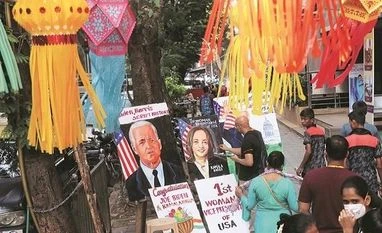
People walk past an artist applying finishing touches to a painting of US Vice President-elect Kamala Harris, in Mumbai on Sunday. Photo: Reuters
Aditi PhadnisDilasha Seth New Delhi
4 min read Last Updated : Nov 09 2020 | 6:08 AM IST
As congratulatory messages poured in from world capitals for Joe Biden and Kamala Harris on taking command of the US government, the Indian diaspora recalled the policy paper released for relations with India and the community on August 15 this year.
 
The paper said: “Biden will deliver on his long-standing belief that India and the US are natural partners, and a Biden Administration will place a high priority on continuing to strengthen the US-India relationship. No common global challenge can be solved without India and the US working as responsible partners.”
 
Among specific commitments were helping India become a permanent member of the UN Security Council, continued co-operation on terrorism, strengthening ties on issues like climate change and health; and working towards a multifold increase in bilateral trade. The paper also promised a more compassionate view on the 11 million illegal immigrants in India (which includes 1.7 million from Asia and around 500,000 from India). It promised a review of the H1B visa system by “expanding the number of visas offered and eliminating the limits on employment-based visas by country.”
 
Reports from Washington said work has already begun to deliver on some of these promises, possibly within days of taking office in January. Said Swadesh Chatterji, entrepreneur and close personal associate of Biden: “Biden has always supported the cause of India-US relationship. But for the role he played as chairman of the Senate Foreign Relations Committee, the historic civil nuclear deal would never have been passed by the US Congress,” Chatterjee said.


Indian trade bodies and lobby groups had high hopes of normalisation of economic ties with the US.
 
“We believe that the Biden Administration will not indulge in retaliatory tariff wars or impose ad hoc duties in a unilateral manner like Trump. This is expected to being in some predictability in the trade regime, which will help strengthen bilateral relations. Besides, uncertainty is most dangerous for trade,” said Ajay Sahai, director general & CEO, Federation of Indian Export Organizations.
 
India’s trade surplus with the US has seen a steady decline under Trump’s regime with Washington pressing New Delhi to cut tariffs on US imports like motorcycles price controls on pharma and medical equipment. The trade surplus declined from $21.2 billion to $18.6 billion. India was forced to cut Customs duty by half on imported motorcycles like Harley-Davidson to 50 per cent after Trump called it “unfair”.


The US last year hiked tariffs on steel imports by 25 per cent and aluminium imports by 10 per cent, which saw retaliation from India in the form of increased tariffs on 29 high-value US agricultural and industrial imports by up to 50 per cent.
 
Biden may dump unilateralism as a trade response in favour of multilateralism and bilateralism, feel experts.
 
“The Biden Administration will also follow the Trump administration’s logic of trying to put pressure on the Chinese and to get them to abide by international treaty obligations included in the WTO. But they would put pressure in a much more diplomatic way — in a coherent way, and in a multilateral or bilateral manner, rather than unilateralism,” said Jayant Dasgupta, India’s former Ambassador to the World Trade Organization.
 
He said Biden was expected to get back the WTO on the rails but would focus more on plurilateralism like restarting negotiations on the Comprehensive and Progressive Trans Pacific Partnership (CTPP), expected to be the world’s largest trade deal covering 40 per cent of the global economy. India, though, is not a participant in TPP. “It is likely that the US will come back at the WTO table to reform the multilateral organisation. The appellate body is virtually absent now, with several cases pen
ding against the US itself. That might change,” said Dasgupta.
 
He said the US increased duties on Indian steel and aluminium in the past few years, as it did for the alloy and the metal from China, Brazil, and a host of other countries. “These matters are pending with WTO, which might get closure that benefits India,” said Dasgupta.

One subscription. Two world-class reads.

Already subscribed? Log in

Subscribe to read the full story →
*Subscribe to Business Standard digital and get complimentary access to The New York Times

Smart Quarterly

₹900

3 Months

₹300/Month

SAVE 25%

Smart Essential

₹2,700

1 Year

₹225/Month

SAVE 46%
*Complimentary New York Times access for the 2nd year will be given after 12 months

Super Saver

₹3,900

2 Years

₹162/Month

Subscribe

Renews automatically, cancel anytime

Here’s what’s included in our digital subscription plans

Exclusive premium stories online

  • Over 30 premium stories daily, handpicked by our editors

Complimentary Access to The New York Times

  • News, Games, Cooking, Audio, Wirecutter & The Athletic

Business Standard Epaper

  • Digital replica of our daily newspaper — with options to read, save, and share

Curated Newsletters

  • Insights on markets, finance, politics, tech, and more delivered to your inbox

Market Analysis & Investment Insights

  • In-depth market analysis & insights with access to The Smart Investor

Archives

  • Repository of articles and publications dating back to 1997

Ad-free Reading

  • Uninterrupted reading experience with no advertisements

Seamless Access Across All Devices

  • Access Business Standard across devices — mobile, tablet, or PC, via web or app

Topics :Joe BidenUS Presidential elections 2020

Next Story



