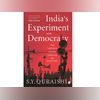
India’s Experiment with Democracy: The Life of a Nation through its Elections
With India’s election season kicking off, can books on elections be far behind? This one, by a former Chief Election Commissioner S Y Quraishi (who was CEC between 2010 and 2012), will likely be the most credible and comprehensive. Mr Quraishi has double qualifications — he was also a pillar of the Indian Administrative Service (IAS), the first Muslim from Old Delhi to have acquired that distinction, meriting an editorial in The Hindustan Times. He also records that he is an acknowledged expert on German grammar and many took advantage of this; and while at the Lal Bahadur Shastri National Academy of Administration in Mussoorie, he founded a rock band that survives to this day.
Mr Quraishi has organised the book around three themes: The conduct of elections; laws related to polls; and the stories around the men who supervised India’s elections, the global “gold standard” per Senator Hillary Clinton. He touches on the issue of simultaneous elections and says the idea is a good one in principle because multiple elections drag down administration, but political consensus needs to be evolved around it. He also suggests other ways of strengthening the democracy framework so that frequent elections are avoided, such as disincentivising MLAs and MPs from changing party loyalties. He flags the issue of state funding of elections (“an idea worth considering”) and a cap on the expenditure incurred by political parties in polls, including a ban on private and corporate fund collection by parties (at the very least, he advocates lifting the secrecy around electoral bonds).
Mr Quraishi talks about bribery in polls — freebies and such — but also records the increasing role of money in elections that led to the unprecedented step of the Election Commission (EC) cancelling two Assembly elections in Thanjavur and Aravakurichi constituencies in 2016 for corrupt practices. He expresses his surprise that the Narendra Modi government, despite its avowed intention of weeding out black money, rejected the proposal twice that the EC be given permanent powers to cancel elections on credible evidence of abuse of money. He touches on the Model Code of Conduct (MCC), the role of Governors and other aspects of holding elections, including the role of exit polls, media and hate speech.
In this context the EC becomes a pivot of power. When Mr Modi dissolved the Gujarat Assembly in 2002 after the Gujarat riots and wanted elections to be held quickly, the EC judged it was too soon as law and order had not normalised. At public meetings, Mr Modi uttered the words “James Michael Lyngdoh” (CEC 2001-04) leaving the crowd under no illusion that he differed with the EC. He also referred to Mr Lyngdoh’s religion (Vadodara rally 2002). This is possibly the first time a CEC featured in politics so directly.
The matter was referred to the President of India who referred it to the Supreme Court, which sided with the EC. Although Mr Quraishi does not refer to this incident, he does talk about two Bharatiya Janata Party (BJP)-government EC appointees, O P Rawat and A K Jyoti, who ruled impartially in the 2014 Gujarat Rajya Sabha election when two Congress MLAs cross-voted in BJP’s favour and showed their vote to the BJP in violation of secrecy. The Congress was furious and wanted the election cancelled. But the votes had already been mixed in the ballot box. Who was to say who voted which way? Messrs Jyoti and Rawat ruled there was no dispute. Mr Quraishi applauds them.
While Mr Quraishi has unreserved admiration for T N Seshan and Sukumar Sen, India’s first CEC (1950-58), there are some controversies he has not addressed. M S Gill went from being a senior bureaucrat to CEC and then a Congress MP. He is the first CEC to have become a minister in the central government. This casts a shadow on his objectivity in some of the rulings he may have given in election disputes. You could argue that Seshan, who contested the election for President against KR Narayanan and lost should be judged by the same yardstick. Mr Quraishi does not refer to either. Nor does he speak about the only resignation of an Election Commissioner: Ashok Lavasa from Mr Quraishi’s own cadre, Haryana, who differed on whether PM Modi and Home Minister Amit Shah had violated the Model Code of Conduct.

 "A practitioner's guide to elections")












 Connect with us on WhatsApp