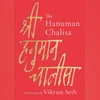
Translated by Vikram Seth
Vikram Seth made his debut as a novelist in 1986 with The Golden Gate. It was a novel written in verse composed of 590 stanzas or sonnets that narrated the story of a group of young people living in San Francisco, interpreting life, searching for adventure and trying to understand the meaning of love. In subsequent years, Seth wrote several other novels, the most famous of them being A Suitable Boy, which cemented his place among India’s top fiction writers in English.
Almost 38 years after he wrote his first novel, Seth has returned to the verse form. But this time he has chosen to translate one of the most popular and widely recited poems of Tulsidas, the 16th century Vaishnava poet who wrote in Sanskrit, Awadhi and Braj Bhasha. It is a short poem — Hanuman Chalisa — which is a hymn to Hanuman, the supremely powerful monkey in the Ramayana whose unparalleled devotion to Rama and his wife, Sita, elevated him to the status of a god. It has 43 couplets and is commonly recited by many Hindus not only on religious occasions but also to ward off evil or to ensure success in any endeavour.
There is no precise reason why Seth decided to undertake the translation of Hanuman Chalisa into English. A plausible reason could be that he wanted more people to understand the intricate nuances and connotations of how Tulsidas celebrated the power and greatness of Hanuman. Tulsidas wrote Hanuman Chalisa in Awadhi, a language that is not easy to comprehend even for Hindi-speaking people. The other reason perhaps is his own love for this poem. In a brief introduction to
The short poem, running into just about 100 pages, has been translated with a lot of care and sensitivity keeping in mind what should make the poem more accessible to the readers. There are no endnotes or footnotes to explain the poem’s context and relevance. Nor does Seth needlessly dwell on the intricacies of the metre that Tulsidas uses and the rhythm that he manages to achieve. He avoids them so that these explanations (so detailed and boring that they could often sound pedantic) do not come in the way of readers enjoying the simplicity and pristine appeal of the poem. The translator achieves that goal quite remarkably.
Yet, Seth employs a highly evolved technique to help readers enjoy the rhythm and flow of Hanuman Chalisa. Apart from the English translation, each of the original Awadhi couplet of Tulsidas is presented in Devnagari script, followed by its simple phonetic transliteration in English alphabets without any superscript, subscript, italicisation or diacritical mark. In the transliteration exercise, he follows a simple set of rules to indicate short vowels, long vowels and diphthongs. Following a widely used practice, he separates two vowels sitting next to each other within a word with a hyphen.
Additionally, the English translation has succeeded in arousing the Bhakti Rasa or the devotional spirit as effectively as the original poem by Tulsidas.
One subscription. Two world-class reads.
Already subscribed? Log in
Subscribe to read the full story →
Smart Quarterly
₹900
3 Months
₹300/Month
Smart Essential
₹2,700
1 Year
₹225/Month
Super Saver
₹3,900
2 Years
₹162/Month
Renews automatically, cancel anytime
Here’s what’s included in our digital subscription plans
Exclusive premium stories online
Over 30 premium stories daily, handpicked by our editors


Complimentary Access to The New York Times
News, Games, Cooking, Audio, Wirecutter & The Athletic
Business Standard Epaper
Digital replica of our daily newspaper — with options to read, save, and share


Curated Newsletters
Insights on markets, finance, politics, tech, and more delivered to your inbox
Market Analysis & Investment Insights
In-depth market analysis & insights with access to The Smart Investor


Archives
Repository of articles and publications dating back to 1997
Ad-free Reading
Uninterrupted reading experience with no advertisements


Seamless Access Across All Devices
Access Business Standard across devices — mobile, tablet, or PC, via web or app
)