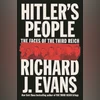
HITLER’S PEOPLE: The Faces of the Third Reich
Author: Richard J Evans
Publisher: Penguin Press
Pages: 598
Price: $35
Who Goes Nazi? is an old essay by Dorothy Thompson that has been making the rounds over the last several years. Writing for Harper’s Magazine in 1941, Thompson suggested playing a “macabre parlor game” to figure out who would sign on to fascism “in a showdown.” Decades later, Thompson’s proposal resonated with Americans who were seeking any glimmer of insight into how far-right extremism had gathered startling levels of popular support.
For Thompson— one of the first American journalists to be kicked out of Germany, in 1934 — the crucial factor distinguishing potential fascists from those who would “never go Nazi” was not “race, color, creed or social condition.” Rather, she argued, it was “something in them.”
Such a fixation on individual character would probably irritate the eminent historian Richard J Evans, but the question he poses in his kaleidoscopic new book, Hitler’s People, isn’t so different. “Who were the Nazis?” he asks in the first sentence of his preface. Were they criminals? Psychopaths? Ordinary Germans? How did seemingly respectable citizens go from rejecting the democracy of the Weimar Republic to countenancing genocide?
Evans, whose trilogy on the Third Reich has been justifiably lauded for its elegance and its scope, previously shied away from a biographical approach to his subject. For a half-century after World War II, focusing on individual personalities was deemed “unfashionable,” he writes, an unseemly reprise of Nazi Germany’s cult of personality, which pinned so much on Hitler that it risked letting “the great mass of Germans” off the hook. But the availability of new documents, as well as the “emergence in our own time of a class of unscrupulous populist politicians,” prompted Evans to revisit a history he knew well.
The result is a fascinating exploration of individual agency that never loses sight of the larger context. Given the number of excellent biographies that have inspected every crevice of Hitler’s personality, Evans’s portrait of the Führer turns out to be the least surprising part of this book. Hitler, he says, was undeniably a singular figure — an opportunist and also an ideologue, a committed anti-Semite who knew how to dial down the anti-Semitic ranting when it wouldn’t play well with an audience.
But Hitler was “neither a political nor a military genius,” Evans writes. “He had the good fortune to enter politics at a time when public speaking, live and before vast crowds, enjoyed its greatest potency.” Hitler also benefited from the suffering caused by World War-I and the Treaty of Versailles, which was later compounded by the economic calamity of the Depression. Hitler was a hateful demagogue who happened to arrive at the right place and the right time to seize power.
Larger questions of time and place come up for Evans again and again, even as he hews closely to the specific personalities and experiences of the people he writes about. There are obvious differences among them. Some, like Julius Streicher, the editor of the Nazi newspaper Der Stürmer, and the Nazi theoretician Alfred Rosenberg, were already vicious, “visceral” anti-Semites when they joined the movement; others, like Hermann Göring, initially exhibited the kind of antisemitism that Evans calls “perfunctory and conventional.” Heinrich Himmler “did not have a lifelong obsession with the imaginary threat posed to the ‘Aryan’ race by the Jews,” but he was virulently homophobic. As one of the architects of the final solution, Himmler kept pushing Hitler to expand the scope of the Holocaust.
What Hitler’s people had in common, Evans says, was the shared trauma of total defeat in World War-I. Hitler’s endorsement of the “stab in the back” myth, which blamed the Jews for Germany’s defeat in the war, offered the easy lie of a noxious conspiracy theory in place of the hard truth, that Germany was incapable of defeating the Anglo-American coalition. Hitler created a “moral milieu” that selected for the cruellest, vilest behaviour.
But Hitler would have gone nowhere if it weren’t for the conservative elites who invited him into power in the first place. Business leaders and the military may have had “misgivings” when it came to the brutal tactics of the Nazis, but they hated Weimar’s democracy even more. Evans includes a chapter on Franz von Papen, one of the establishment politicians who helped ensure Hitler’s appointment as Reich chancellor in 1933. The aristocratic von Papen later admitted to underestimating Hitler.
After the Holocaust, von Papen insisted he had nobly acted as the sober adult in the room, making the preposterous claim that he had worked hard “to keep the anti-Jewish excesses of the Nazis within bounds.”
Hitler’s People is an unexpected book for Evans, and not only because of its biographical focus. In January 2021, not long after the rampage on the Capitol, Evans wrote an article criticising those who argued that the history of fascism offered insights into what was taking place in the United States. “You can’t win the political battles of the present,” he admonished, “if you’re always stuck in the past.”
Evans ends his new book with a sentiment that does seem like something of a departure. It is only by understanding “how Nazism exerted its baleful influence,” he writes, that “we can perhaps start to recognize the threats that democracy and the assertion of human rights are facing in our own time, and take action to counter them.” With Hitler’s People, Evans has provided us with just the kind of probing, nuanced and unsparing study to help us think things through.
The reviewer is the nonfiction book critic for The Times
©2024 The New York Times News Service

 "'Who were the Nazis?': This book asks key questions about men behind Hitler")


 Connect with us on WhatsApp