Chasing Salah: The Biography
Publisher: Constable (Little, Brown)
When Mohammad Salah arrived at Liverpool Football Club in 2017, he was the classic underachiever. Loaned out by Chelsea Football Club in 2015, after scoring two goals in 13 appearances, to Italian clubs Roma and Fiorentina, he registered underwhelming statistics — just 35 goals in 81 matches. Since he joined Liverpool, for a (then) club record signing of £36.9 million under the legendary Jurgen Klopp, he has scored 241 goals in 387 games. Add 108 assists and Salah has been involved in 349 goals in those matches – a stupendous achievement for a midfielder. He has won the Golden Boot three times and, at age 32, is on track to win it this season too.
In the number 11 shirt, Salah has played a leading role in powering the Reds to their first championship in the Premier League era (2019-20). That same year, Liverpool did the double, winning the UEFA Champions’ League with Salah scoring in the final. Salah was the top scorer for the club in all competitions that year. He’s also won the FA Cup and League Cup champion (twice) with the Reds.
And yet, in a business where players and their families are under the microscope every waking hour, Mo Salah remains an enigma. He attracts none of the usual headlines about star footballers’ extra-curricular activities — drunken brawls in nightclubs, high rolling lifestyles, infidelities, obligatory supermodel wives or girlfriend in tow. When he’s not on the pitch or the gym, he lives quietly with his wife Magi and two daughters, who rarely appear in public.
Incredibly, despite near-invisibility off the field and absence of notably inspiring public utterances, the ever-smiling Salah has exerted a positive influence on local society — at least on the Red side of Merseyside. As Simon Hughes, the football journalist who sets out to unravel the Salah mystique in Chasing Salah writes in the Introduction, Salah’s goal celebrations ritually include practising the sujood the act of prostration in Islamic worship that has helped lift the “barrier of negative perception about Muslims that so many leaders and institutions could not”.
Liverpool fans call Salah the “Egyptian King” and chant “I’d be a Muslim too” when they serenade him. In fact, Hughes writes, a study by Stanford University showed that the number of hate crimes on Merseyside fell after Salah’s arrival at Liverpool. There were 18.9 per cent fewer crimes predicted and a 53 per cent fall in anti-Muslim posts among Liverpool fans. In 2019, he was on the list of Time magazine’s 100 most influential people. In Egypt, the money he has poured into schools and infrastructure in his native Nagrig has made him a national role model.
Chasing Salah is Hughes’ valiant attempt to offer a fuller portrait of the man. He is hamstrung by the fact that Salah almost never gives interviews, this book included. When he speaks to the press, it’s about football. Even CNN’s Becky Anderson’s cloying 2018 interview failed to yield revelations beyond his admiration for Zinedine Zidane, Ronaldo (the Brazilian), Franceso Totti and Steven Gerrard. Afterwards Ms Anderson said she discovered that Mo was — surprise, surprise — ambitious, competitive and a really nice guy.
He has attracted attention beyond football just twice. Once when he stated in the Time interview, that West Asian men should treat women better. The second was more recent, a dignified call for “world leaders to come together to prevent further slaughter of innocent souls” following the demolition of the Gaza City hospital by Israeli missiles.
Otherwise, Salah non-football social media utterances are gnomic. “His discretion has meant that, although he is always there in plain sight, we barely really know him,” Hughes writes. This is understandable; Salah comes from a football crazy but deeply authoritarian country; his every move and utterance is monitored, a precarious situation given that he has close family in Egypt. His family and acquaintances are likewise niggardly with information about him.
At the end of Chasing Salah we are no closer to knowing the most famous Arab footballer on the planet any better than we do watching his scorching runs down the right wing and his breath-taking goals. We get bits and pieces, such as his admiration for Cristiano Ronaldo’s workout routine (but less so his footballing skills) and diet which he sought to follow – building the upper body strength that makes him freakishly strong against the burliest defender and ensuring that he rarely gets injured.
We discover that his reading habits are eclectic. In 2018, after Egypt’s ignominious exit from the World Cup, he posted a photograph of himself reading the Arabic translation of Mark Manson’s best-seller The Subtle Art of Not Giving a F**k (which instantly became a best-seller in Egypt). He also likes the Arabic translation of Dawn of Conscience which extolled the virtues of ancient Egyptian civilisation. Napoleon Hill’s Think and Grow Rich is his favourite book.
This does not mean that Chasing Salah is an uninteresting book. Hughes manfully puts in the hard yards, tracing the 120 km journey Salah made every day at age 12 from dirt poor Nagrig, in northern Egypt to his first football club on the outskirts of Cairo. This involved using an unreliable and informal network of micro-buses – a “sardine can on tyres” – changing four times till he reached his destination. At the end of the practice session, he took the same three to four-hour journey back.
Hughes usefully sets the political and social context in which Salah grew up, a country relegated to the bottom third among developing countries by the Human Poverty Index, the result of Hosni Mubarak’s warped deregulation and privatisation programmes. Salah’s family came from one of the few lower middle income families in the village. His mother, whose name is not disclosed at the family’s request, was obsessed that her rake-thin son, who played football in an outsize tee and baggy jeans, received an education in the local school now named after him. His father Ghaly had a job with the ministry that handled jasmine supply, one of Nagrig’s main crops, and could afford to finance his son’s initial football ambitions.

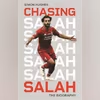 "Chasing Salah: Simon Hughes' valiant attempt to decode the enigma")












 Connect with us on WhatsApp