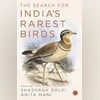
The Search for India’s Rarest Birds
Editor: Shashank Dalvi & Anita Mani
Publisher: Juggernaut
Pages: 280
Price: ₹499
This book is about those birds of India that have intrigued, mystified and often disappeared out of public consciousness for decades. Some of these birds have been brought back to “life” and to science, by the blood, sweat and tears of bird enthusiasts who have dared to explore and re-explore remote sites to which few others have been. Each of the 12 authors has traced the history of exploration of their study species, beginning in the 19th century, and also inform us about their little-known ecology.
Common to all these cases is the diehard attitude of each of the ornithologists who were determined to find their “target” bird species, come what may. These bird explorers thought nothing of trekking through miles of tough terrain, driving through flood-prone causeways or spending night after night on insect-infested beaches in pursuit of these fascinating birds. Nor did they baulk at repeat visits to likely habitats despite the poor probability of success.
Along with important information on birds, The Search for India’s Rarest Birds also turns the spotlight on the lives of ornithologists and bird-lovers, and tells us what lies behind the glamour of wilderness expeditions and the systematic field work that often yields valuable results. But, as Sayam Chowdhury, one of the authors, eloquently writes: “… the memories are not of hardships but of the positive moments... It’s a journey that goes beyond the confines of scientific exploration: it’s a narrative of connection, of humans and nature intertwined in a delicate dance.”
The Search for India’s Rarest Birds showcases India’s incredible bird diversity, amounting to more than 1,350 species. We are lucky to have the Nicobar megapode or “thermometer bird”, which has the most bizarre nesting behaviour among birds. It builds a large communal nest-mound out of dead vegetation, which it uses and replenishes year after year. The account of the Nicobar megapode by Radhika Raj stands out because of its lively narration that doesn’t leave out any work-day details. In another chapter, the history of the effort to record the Banasura laughingthrush that lives in the montane sholas — amounting to a tiny sliver of space in the mystical heights of the southern Western Ghats — is described beautifully by Praveen J.
Aasheesh Pittie writes an engaging account — replete with history — of the pink-headed duck that is believed to have become extinct in 1935. From the medieval Indian artist Bhawani Das, who first painted the duck, to numerous colonial-era naturalists such as Thomas Jerdon, Pittie has painstakingly traced every casual mention, museum specimen, and scientific record of the species. The interesting-looking pink-headed duck lived in secluded pools in the marshy lowlands of Bihar, Nepal, Uttar Pradesh and Assam. It faced the brunt of wetland drainage and clearing for agriculture and settlement since at least the 18th century. Already low in numbers and scattered across the Terai, the species faced the additional threat of collection for menageries in both India and Europe in modern times. Pittie’s account offers fascinating and rare insights into the human-triggered processes that could eventually lead to the extinction of such extreme habitat specialists.
Sadly, most of the other species that have been written about in the book could also be well on their way to extinction if we don’t dramatically change the way we use our land. Till today, we have not been able to provide guarantees against the looming threat of infrastructure development or provide escape mechanisms from climate change to wild species. A case in point is the Nicobar megapode that suffered a 70 per cent reduction in numbers owing to the catastrophic tsunami of 2004. This species is once again in the crosshairs due to the construction of the large transshipment port planned in Great Nicobar that will obliterate one of its key remaining habitats.
Similarly, less than a hundred individuals of the masked finfoot are believed to survive in its best-known breeding area, the mangroves of the Sundarbans. No one knows why this elusive bird has declined to such low numbers in what is a relatively untouched forest. Based on years of observation, the author Sayam Chowdhury suggests that it could be the increasing salinity of the mangrove waters due to sea level rise over the last few decades.
The Search for India’s Rarest Birds is an extremely interesting read for anyone who wants to know more about birds. I recommend it highly for naturalists, students, forest managers, policy-makers and everyone else who may be interested in the birds around us that often go unseen and unrecorded. Perhaps these detailed accounts of how and where rare birds still survive will create awareness about India’s remarkable biodiversity, and trigger some action against “development” projects that threaten to ride roughshod over our remaining wild habitats.
The reviewer is an ecologist researching the effects of forest conversion, fragmentation and degradation on birds and trees in the western Himalayas and also works on wildlife policy and politics in India. She is currently a visiting professor with Ashoka University