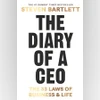
THE DIARY OF A CEO: The 33 laws of business and life
Author: Steven Bartlett
Publisher: Penguin Random House
Pages: 368
Price: Rs 799
This book is an inspirational and relevant read for successful managers in middle to top leadership who wish to be prepared for the corner office. The 33 laws described — if you believe in laws for CEOs at all — would surely be useful for such people. Those who are outside this target group may find the book a less exhilarating read because seasoned players may consider the book to be glib, while the parvenus may find it a heavy read for what is essentially common sense. The book will appeal to those in the middle of the greasy pole because by then they would have realised that management is replete with the uncommon lapse of common sense. In short, if you are earnest, read it. If you are cynical, do not. You decide.
There are four “phases” in the book, akin to a plane ride. It takes off with “The Self”, moves up to “The Story”, peaks at “The Philosophy” before levelling off with “The Team”. The 33 laws are distributed among these four sections. The book is a well organised and easy read. While comprehension will not be an issue for the reader, retention, practice, and mastery could. This should not surprise; otherwise, there would be several thousands of top-class CEOs with an MSc in the 33 laws. Some examples of the laws follow.
In the section on “The Self”, there is an exhortation to teach. A yogic leader is quoted, “If you want to learn something, read about it. If you want to understand something, write about it. If you want to master something, teach it.” This is sound advice. During my early career, my employer, Hindustan Lever, encouraged us to teach even younger managers at the company training centre, GULITA. Nobel awardee Richard Feynman is reported to have said, “If I could not reduce a subject to a freshman level, I really did not understand the subject.” The book rightly argues that you become a master, not because you are able to retain knowledge, but because you are able to “release it.” (Since I have written as many as 18 books, I can now righteously say that all that I am doing is to “release my knowledge and experience”.)
Another law is about leaning in rather than leaning out. Leaning out is about being so sure of yourself that you refuse to listen or pay attention to new ideas. This is a disease to which every upcoming leader is prone. In 1903, a banker told Henry Ford, “The horse is here to stay, but the automobile is a fad.” More recently, Steve Ballmer of Microsoft said of Apple, “There is no chance that the iPhone is going to get any significant market share.” The founder of Nissin Corporation, Momofuku Ando, was advised in 1948 to abandon making ramen (instant noodles), but he persisted, and went on to build a global corporation.
So, how can you learn to lean in? When you don’t understand a subject, reserve your judgement, just lean in. Listen three times as much as speaking. Here is a story that I heard from the legendary F C Kohli. In 1974, the late Faqir Chand Kohli pleaded with JRD Tata and Nani Palkhivala to import one machine for ~4 crore. He said, “I will ensure that Tata Consultancy will repay Tata Sons for many, many years,” JRD and Palkhivala leaned in. The results are there to be seen in Tata Consultancy’s development into a mega corporation.
In the section “The Philosophy”, Law number 19 is stated to be “Sweat the small stuff”. Given that upcoming managers are assaulted by injunctions such as “Winner takes all” or “Disrupt and destroy” or “Big hairy audacious goals”, this is sane advice. Toyota’s fabled technique of kaizen — continuous improvement—has revolutionised automotive manufacturing. In 1983, General Motors closed its Fremont facility for lack of viability. Former Toyota Chairman Eiji Toyoda offered to partner GM in reviving Fremont. By re-employing 90 per cent of the same employees, retraining them at the Japanese Toyota City facility, the new venture acquired fame as the incredibly successful NUMMI — New United Motor Manufacturing Inc.
Under the kaizen system, the supervisor is the “ideas coach”, whose job is not to say yes or no to ideas, but to help the employee to improve the quality of suggestions and make them practical. This law states that you must sweat the small stuff, year after year. In financial investment strategy, they call this the exponential benefit of the compounding effect.
Another law quotes Charles Darwin: Nature teaches us that gradual evolution, mutation, and adaptation are prevalent. The book states that a small miss now results in a big miss later. Tiger Woods, the fabulous golfer, adopted an obsessive, continuous, tiny improvement approach to his game —and credits his success to this approach. He applied kaizen to his golf game. Speaking for myself, I have deep awareness and knowledge of this law, but my golf game is stuck at a mediocre handicap, without doubt due to my inconsistent practice of continuous improvement.
In summary, this is a practical book. One can read it and feel good. An alternative is watching the film Lage Raho Munna Bhai, in which the lead actor takes inspiration from Gandhiji to solve common problems of common people. However, benefit in either case can be derived only through a two-point cycle: Practice and improve fiendishly.
The reviewer is an author and corporate commentator