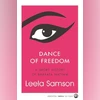
Dance of Freedom: How Bharata Natyam became India's quintessential dance

Padma Shri Leela Samson traces the journey of Bharata Natyam through its origins, controversies, costumes, and philosophy, while reflecting on its enduring inclusivity and timeless appeal

Dance of Freedom: A Short History of Bharata Natyam
Neha Kirpal New Delhi
5 min read Last Updated : Sep 19 2025 | 10:33 PM IST
Dance of Freedom: A Short History of Bharata Natyam
By Leela Samson 
Published by Aleph
86 pages, ₹399
  In this concise book, Bharata Natyam dancer, choreographer, instructor, writer and actor Padma Shri Leela Samson explores the ancient classical dance form of Bharata Natyam, tracing its origins, history, and evolution over the centuries. Samson delves into various aspects of the form, including its schools and styles, techniques and symbolism, as well as costume and attire. The final chapter examines Bharata Natyam in the present day — the 21st century and beyond. 
With decades of experience, Samson received her training in Bharata Natyam at the Kalakshetra Foundation in Chennai, and became its director in 2005. In the book’s Prologue, she writes that Arangetram (or Rangapravesam) — the debut solo performance of a Bharata Natyam dancer — was not a word with which she was familiar as a child. Later, while studying at Kalakshetra too, Rukmini Devi, who founded the academy, did not wish students to learn the dance with the intention of doing their Arange­tram. However, Samson did finally have her two-and-a-half-hour debut solo performance in Bombay in 1970, a day after her 19th birthday. 
Samson goes on to explain that the history of Bharata Natyam in the last 300 years is mired in controversy and confusion. The early-day performer of the dance form was referred to as a devadasi, or a handmaiden of god. “Performed simultaneously in the temples, in the courts of kings, and in public for utsavams or festivals, the women who performed at these different venues were different in the training they had, in the kind of compositions they performed, in the compensation they received for their work, as also in their standing in society,” she writes. 
In 1784, the law courts headquartered in Bengal, Madras, and Bombay summarily classified all dancing girls across the Indian subcontinent as a “professional” class of public entertainers. It was during the 19th century that the transformation of Bharata Natyam, particularly concerning the court repertoire, devadasi system, royal patronage, and colonial influences, significantly shaped its trajectory. 
Samson attributes Gangaimuthu Nattuvanar, grandfather of the Tanjore Quartet, and Rukmini Devi — living during the 18th and 20th centuries, respectively — with creating and then recreating the form of Bharata Natyam as we now know it. “Each did in their own time what was necessary to enhance the pedagogy of the form and draw attention to its intrinsic beauty,” she writes. In 1936, Rukmini Devi established the International Academy of Arts, later renamed Kalakshetra in Madras. “Scholars were put on the job, old texts disseminated, elderly musicians and dancers engaged, a gurukulam created under the trees, and children enrolled from among the families living in Adyar, a neighbourhood in south Chennai,” Samson writes. By the 1960s, Bharata Natyam was seen as India’s quintessential dance in cultural exchange programmes with the West. 
Samson elaborates that it was the dancers and musicians of yesteryear who seem to have set the tone for trends in dressing and attire in different social milieus. In the early part of the 20th century, the dancer wore what the deity in the temple was draped with. “She wore the colours of Parvati and Lakshmi, of Saraswathi and Andal, of Valli and Devayani,” writes Samson. In fact, as she points out, it almost seems as though the saree worn by a Bharata Natyam dancer is made for the gods. “Deities like Shiva and Vishnu, Kamadev and Sri Krishna, and a host of other mythological characters come to life in the many different dance representations of them on stage,” writes Samson. 
Deeper in the book, Samson talks about the importance of an early start for children in classical dance traditions. Further, she emphasises the value of repetition beyond question. “Correcting technique until a movement becomes an extension of who you are, is the bedrock of good dancing,” she continues. Samson also highlights the fact that in order to be a sound Bharata Natyam dancer, one must have a thorough knowledge of Indian philosophy, customs and ritual practices. 
Lastly, Samson asks the reader why the ancient dance form has endured over centuries. According to her, the reason is its inclusivity. Bharata Natyam has stood the test of time, absorbing all languages, musical forms, and even all manner of abuse over the centuries. “It is performed by the elite, by slum children, by the non-believer, and the classical alike. It lends itself to classical, pop, folk, and bhajanai sampradaya with equal elan,” she writes. Samson ends by sharing her personal opinion of dance, elucidating that what survives and is tested by time is true, even if there is no audience for it. “Each to his own — live and let live,” she concludes. 
The reviewer is a New Delhi-based freelance writer

One subscription. Two world-class reads.

Already subscribed? Log in

Subscribe to read the full story →
*Subscribe to Business Standard digital and get complimentary access to The New York Times

Smart Quarterly

₹900

3 Months

₹300/Month

SAVE 25%

Smart Essential

₹2,700

1 Year

₹225/Month

SAVE 46%
*Complimentary New York Times access for the 2nd year will be given after 12 months

Super Saver

₹3,900

2 Years

₹162/Month

Subscribe

Renews automatically, cancel anytime

Here’s what’s included in our digital subscription plans

Exclusive premium stories online

  • Over 30 premium stories daily, handpicked by our editors

Complimentary Access to The New York Times

  • News, Games, Cooking, Audio, Wirecutter & The Athletic

Business Standard Epaper

  • Digital replica of our daily newspaper — with options to read, save, and share

Curated Newsletters

  • Insights on markets, finance, politics, tech, and more delivered to your inbox

Market Analysis & Investment Insights

  • In-depth market analysis & insights with access to The Smart Investor

Archives

  • Repository of articles and publications dating back to 1997

Ad-free Reading

  • Uninterrupted reading experience with no advertisements

Seamless Access Across All Devices

  • Access Business Standard across devices — mobile, tablet, or PC, via web or app

Topics :classical danceBOOK REVIEWBook readingBS Reads

Next Story