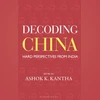
Decoding China: Hard Perspectives from India
By Ashok K Kantha (Editor)
Published by Bloomsbury
416 pages ₹899
This edited volume by Ashok Kantha, former ambassador to China, is an attempt to discuss how Chinese foreign and domestic policy under Xi Jinping have the potential to impact India. Despite the bonhomie displayed by Prime Minister Narendra Modi and President Xi Jinping on the sidelines of the Shanghai Cooperation Organisation summit, Sino-Indian relations are riddled with mistrust and unease. The thaw that began in October 2024 at the Kazan Brics summit after the violent Galwan clashes of 2020, only calls for more caution in India’s engagement with China. The disputed border issue, which has seen no resolution even after multiple rounds of talks, highlights the need for a more nuanced understanding of China. Other global developments — the Russia-Ukraine war, the West Asian conflict and the trade war with the US — add to the challenges in this bilateral relationship.
A detailed introduction by Mr Kantha attempts to paint an overall picture of China and its future direction. As he argues, “It has been observed that Xi’s proactive foreign policy in Asia offers a deal: China will deliver trade, investment and other economic goods, and progressively act as a net security provider to those partners who accommodate, or at least do not challenge, its core interests.” In his essay, Arvind Gupta adds the perspective that, “Although Chinese leaders claim that they are not interested in exporting the Chinese system or model of development to any country, the fact remains that China is building its own sphere of influence.”
China’s “win-win” narrative under its Belt and Road Initiative (BRI) has deepened its engagement with South Asia. Sreeradha Datta provides a detailed picture of BRI-related investments and how this affects India’s position . Tilak Devasher discusses China-Pakistan relations and its bearing on Indian security concerns. This all-weather friendship has proved to be a major challenge for New Delhi and the Chinese inroads in the form of the China Pakistan Economic Corridor (CPEC) has aggravated this challenge. “Pakistan’s inability to meet its defence requirements due to the persisting economic crisis could make Islamabad more dependent on China in the coming years. Concessionary Chinese financing could enable Pakistan to procure advanced weapons systems deemed essential for its national security interests,” he contends. This dependence became glaringly evident during the recent conflict between India and Pakistan.
The consistent weaponisation of trade by China and the widening trade deficit has further reduced India’s manoeuvring power. The Covid 19 pandemic and the lockdowns underscored China’s centrality to global supply chains. As the trade deficit between the neighbours expands, there is an urgent need to focus on ways to reduce this gap. But doing so will not be easy. As Santosh Pai observes in his essay, “Reducing dependency on China for products for which domestic capacity and alternative sources don’t exist will be India’s biggest challenge in preventing weaponisation of trade ties by China”.
Water is increasingly becoming a driving factor in bilateral and regional politics. The root of this lies in Tibet, a point Jayadeva Ranade underscores, “Tibet, also known as the ‘Water Tower’ of Asia, is important for India and the region as it is the source of most major river systems in Asia,” he points out. The recent reports of the Chinese construction of the mega dam in Tibet and the ongoing debates surrounding the reincarnation of the 14th Dalai Lama add a thorny dimension to this relationship.
For all the dominance, the Chinese economy is slowing and unemployment rising consistently, putting additional strains on Xi’s BRI ambitions. Discussing this, Gopal Suri highlights, “The BRI appears to be set for a continued albeit stunted future as China recalibrates its approach to the world amidst the changed realities of an intensified competition with the US and a slowing economy.” The trade and tariff war is compounding Xi’s woes. As Ananth Krishnan argues, what Xi “is able to do will likely determine the success and failure of both his term at the helm and of China’s quest for global supremacy.” Srikanth Kondapalli adds that China’s “geopolitical rivalries have sharpened due to its hostile policies, and ‘weaponisation’ of trade, tourism and other coercive measures against South Korea, Taiwan, Australia, Thailand, Malaysia and other countries have also had a negative impact”.
Though the book traverses a wide canvas and offers detailed and nuanced insights, the reality is that developments connected to China are so vast and immediate that it is difficult to publish a timely book. For no fault of the authors, most of the chapters seem dated when one reads them in 2025. A conclusion that ties all the debates together would have enhanced the value of a book that nevertheless is a much-needed addition to the literature on decoding China from an Indian perspective.
The reviewer is associate professor, OP Jindal Global University