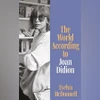
The World According to Joan Didion
Author: Evelyn McDonnell
Publisher: Fourth Estate, an imprint of HarperCollins
Pages: 243
Price: Rs 599
Joan Didion, who died on December 23, 2021, is the pioneering figure of “New Journalism” era in America. But she was also a fashion icon, who often wore big sunglasses on her petite frame, and who once posed for the photographer Julian Wasser rather expressionlessly standing before a Corvette Stingray, holding a cigarette in her right hand, looking remarkably angelic.
But Didion was so much more than the sum of these parts, as this latest biography by Evelyn McDonnell, demonstrates. As she points out in The World According to Joan Didion, it takes an astute, silent observer and immense control of one’s craft to transform a piece titled “San Francisco Job Hunt,” slated “to be intended as a self-help/travel piece for young women interested in West Coast,” into “an investigation of gender inequity”.
Ms McDonnell, a Californian like Didion, brings her distinct feminist sensibilities to recreate the time Didion inhabited or helped shape. Often mimicking Didion’s style (which occasionally irks), Ms McDonnell takes the reader through Didion’s agrarian roots, her fear of snakes, and her obsession and dream to be with someone tender yet masculine— such as John Wayne.
About Wayne, Didion famously wrote, “Heard him tell the girl in a picture called War of the Wildcats that he would build her a house, ‘at the bend in the river where the cottonwoods grow’. As it happened, I did not grow up to be the kind of woman who is the heroine in a Western, and although the men I have known have had many virtues and have taken me to live in many places I have come to love, they have never been John Wayne, and they have never taken me to that bend in the river where the cottonwoods grow. Deep in that part of my heart where the artificial rain forever falls, that is still the line I wait to hear.” That’s vintage Didion, leveraging memories as material and desires as lede to formulate an argument, present a picture, and begin a story that would unfold as she writes it.
Ms McDonnell seeks to deconstruct the writer for her fans. She notes that though Didion would “retreat behind a screen of pages” the reporter in her surfaced soon enough to “look around, ask questions.” Dissecting a classic Didion sentence, “To sit by the Royal pool and read The New York Review of Books is to feel oneself an asp, disguised in a voile beach robe,” Ms McDonnell can’t help but marvel at her choice of words. Hemingwayesque in tone, Didion’s prose was chiselled to uncover “a deeper, and often unstable, core”, Ms McDonell says.
Often emotive, her sentences were framed to exercise the brute freedom that writers have to impose “oneself upon other people, of saying listen to me, see it my way, change your mind, as she wrote in Why I Write.
If, like me, you are obsessed with Didion, then there’s not enough that’s new in Ms McDonnell’s book; most of the information is already supplied in a documentary Didion’s nephew Griffin Dunne made for Netflix, The Center Will Not Hold (2017).
Although there are many fresh anecdotes in this book, it fails to captivate because the writer seeks to be defensive about Didion. On the other hand, when she appears to be critiquing Didion, her arguments are lubricated with contemporary, self-serving wokeness.
What does work in Ms McDonnell’s favour, however, is the structure of this book. Divided into 14 chapters, all of which are titled with things, beings, and words associated with Didion, for example, Gold, Notebook, Stingray, Snake, etc, the book reveals the core of the mythic Didion. Ms McDonnell’s assessment of Didion is perceptive. Though it’s undeniable that many notice Didion’s style, her “belletrist” and rhythmic form of writing, it’s crucial to underline that far too few people focus on the fact that she’s desperately trying to locate herself.
For this neurotic writer, it was essential to find order in the scheme of things, which is why she wrote. Or as Ms McDonnell puts it wonderfully: “She recorded what was in her mind, not her reality. ‘Remember what it was to be me: that is always the point.’” This is why for writers this book will still unfold differently. The word on the street is that Didion is a writer’s writer. “Narrative was her expertise and her enemy,” as Ms McDonnell writes. That sounds hard to accept for someone who “chose every word with machinelike precision” and had mastered the “functional economy of public prose”. But that was Didion for you: An unsettling dual-natured beast of a writer.