India's place in the new world order

Ambassador Sujan Chinoy's book explores why strengthening the existing multilateral order is crucial, not only for containing China, but also for minimising superpowers' exceptionalism
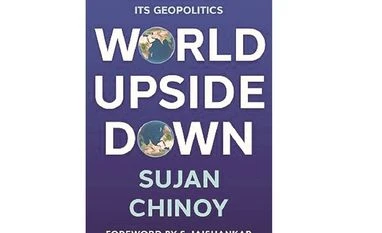
Book
Dammu Ravi
5 min read Last Updated : Sep 12 2023 | 10:07 PM IST
World Upside down: India Recalibrates its Geopolitics
Author: Sujan Chinoy
Publisher: Harper Collins
Pages: 291
Price: Rs 499

The devastation inflicted by the Covid-19 pandemic on humanity and continuing geopolitical tensions have thrown the world into disarray. The belligerent rise of China in these uncertain times and its attempt to create alternative institutions aimed at crafting a new China-led world order is causing serious concern. Ambassador Sujan Chinoy’s book World Upside Down, brings to the forefront these contemporary global developments and the challenges they pose for India.

Also Read


The book is a compilation of the author’s recent articles providing interesting perspectives on global events that impact us all. Russia’s attack on Ukraine, now into its second year, has severely dented the Westphalian principle of “sovereign nation state”. Failing to condemn Russian aggression, even as it projected the invasion as an act of self defence against the North Atlantic Treaty Organisation’s (NATO’s) eastward expansion, exposed the United Nations Security Council’s (UNSC’s) infirmities. The United States’ preoccupation with European security is said to be weakening its resolve to tackle growing tensions in the South China Sea. These developments are limiting India’s options, especially its  sui generis relations with Russia that are underpinned by dependency and compulsions.

The inevitability of Pax China threatening Pax Americana in the new Cold War is prefaced on China deploying wolf-warrior diplomatic tactics. The unabashed imposition of sanctions on exports from Australia, Korea and Japan is the tip of the iceberg. China’s misplaced confidence is attributed to the sudden withdrawal of the US from various geostrategic hotspots such as West Asia, Afghanistan, as well as its receding aggressive posturing in the Taiwan Straits. China scoffs at the US leadership’s expectations that a liberalised China would adopt an American lifestyle and values, undergoing an elliptical political change in the process, as monumental naivety. Likewise, the facilitation of China’s entry into the World Trade Organisation in 2001 continues to devastate manufacturing capabilities even in advanced economies.

India’s successful pursuit of a non-reciprocal “Neighbourhood First” policy through infrastructure projects and capacity-building has paid significant dividends. New Delhi’s failure to seek deeper economic integration in the neighbourhood, Ambassador Chinoy reasons, is unwittingly conceding economic space to China’s Belt and Road Initiative (BRI) projects. Security cooperation in any region is like a chain that is as strong as its weakest link; in that context, terrorism used as an instrument of state policy against neighbours is the weakest point. Similarly, developments in Afghanistan under the Taliban have serious implications for regional stability. The author believes that reactivating South Asian Association for Regional Cooperation (SAARC) not only strengthens India’s “Neighbourhood First” policy, but is also imperative for the credibility of its global leadership.

The chapters on India-China relations are particularly useful for drawing valuable lessons from historical references. The author exposes Chinese duplicity on border talks; its interpretation of the Line of Actual Control in the1959 border settlement with India is as unilateral as it is vague, while Beijing’s rejection of the McMahon Line with India, having amicably settled its boundary with Myanmar in 1960 on the same basis, is perfidious.

It has been reasoned that it is natural for India to expect China to reciprocate on its “One India” Policy in Jammu & Kashmir given that it had respected the “One China” policy on Tibet. The stand-off at the border in June 2020 could not have come at a worse time when the world was still grappling with the fallout of the pandemic. This Chinese misadventure is said to have stalled progress in trade and economic areas. Ambassador Chinoy opines that in dealing with China, India should follow the Chinese cliché  — i.e. “he who tied the knot should untie it”.  

The world is willing to bet on India’s rise but this process should be carefully managed with trust and confidence with a focus on deftly building India-driven resilient supply chains in order to avoid future shocks and disruption as well as reduce dependence on Chinese active pharmaceutical ingredients, auto components, electronics, chips and so on. One gets to understand from the book how India’s absence from the Comprehensive and Progressive Agreement for Trans-Pacific Partnership (CPTPP) and Regional Comprehensive Economic Partnership (RCEP) has given China greater leeway to dominate the region.

In retrospect, this understanding should encourage greater infusion of economic content in the Indo-Pacific region, of which the QUAD is a subset, in order to bring the Association of South Eastern Nations (ASEAN) into its fold. Ambassador Chinoy affirms that to reinforce QUAD solidarity, Japan and Australia too should depict the Line of Control on their maps terminating at point NJ 9842, as the US and UN have done.

While the book captures changing the global dynamics that have resulted in great power contestation as a consequence of China’s push for hegemony, it suggests strengthening the existing multilateral rules-based order for containing not only China but also minimising exceptionalism that superpowers invariably seek. The benign rise of India on the global stage will also strengthen multi-polarity. Notwithstanding India’s rightful place as a permanent member of the UNSC, Ambassador Chinoy admits the process is an uphill task.

The 21st century is largely believed to belong to India and China in which competition and cooperation between them is likely to continue. However, they should not let their differences escalate to disputes in the larger interest of global peace and stability. This understanding is premised on the fact that India and China co-existed for thousands of years and their destiny is tied by the compulsions of geography.

The reviewer is a serving Indian Foreign Service officer

One subscription. Two world-class reads.

Already subscribed? Log in

Subscribe to read the full story →
*Subscribe to Business Standard digital and get complimentary access to The New York Times

Smart Quarterly

₹900

3 Months

₹300/Month

SAVE 25%

Smart Essential

₹2,700

1 Year

₹225/Month

SAVE 46%
*Complimentary New York Times access for the 2nd year will be given after 12 months

Super Saver

₹3,900

2 Years

₹162/Month

Subscribe

Renews automatically, cancel anytime

Here’s what’s included in our digital subscription plans

Exclusive premium stories online

  • Over 30 premium stories daily, handpicked by our editors

Complimentary Access to The New York Times

  • News, Games, Cooking, Audio, Wirecutter & The Athletic

Business Standard Epaper

  • Digital replica of our daily newspaper — with options to read, save, and share

Curated Newsletters

  • Insights on markets, finance, politics, tech, and more delivered to your inbox

Market Analysis & Investment Insights

  • In-depth market analysis & insights with access to The Smart Investor

Archives

  • Repository of articles and publications dating back to 1997

Ad-free Reading

  • Uninterrupted reading experience with no advertisements

Seamless Access Across All Devices

  • Access Business Standard across devices — mobile, tablet, or PC, via web or app

Topics :BS ReadsBOOK REVIEW

Next Story



