Sitharaman picks fiscal discipline over calls for stimulus to economy

Sitharaman will be relying on an ambitious revenue target to narrow the deficit as the government reins in spending: she plans to increase taxes on the wealthy, raise duties on gold and gasoline

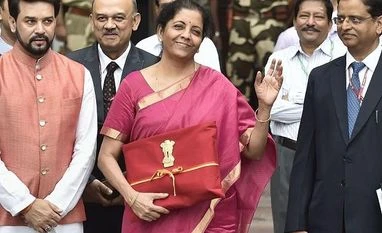
Nirmala Sitharaman, Anurag Thakur
Finance Minister Nirmala Sitharaman with MoS Anurag Thakur and others outside the North Block ahead of the presentation of Union Budget 2019-20 at Parliament | Photo: PTI
Anirban Nag | Bloomberg
4 min read Last Updated : Jul 05 2019 | 9:23 PM IST
Finance Minister Nirmala Sitharaman resisted calls for a fiscal boost to spur a weakening economy, sticking instead to a plan to narrow the budget deficit over time by keeping spending in check.

The fiscal deficit target for the year that began on April 1 was lowered to 3.3 per cent of gross domestic product from 3.4 per cent set in February’s interim plan, the FInance Minister said in her maiden budget in Parliament in New Delhi on Friday. The deficit is forecast to come down even further to 3 per cent of GDP by March 2021, according to the Finance Ministry.

Sitharaman, 59, will be relying on an ambitious revenue target to narrow the deficit as the government reins in spending: she plans to increase taxes on the wealthy, raise duties on gold and gasoline, extract higher dividends from the central bank and boost income from asset sales. On the expenditure side, $11 billion was set aside for farmer support and nearly as much for a capital boost to banks.

Her budget drew applause from bond and currency investors, but left credit rating companies with mixed feelings and stock traders with losses. Yields on India’s benchmark 10-year bonds dropped 8 basis points to 6.67 per cent, while the benchmark equity index closed 1 per cent lower, the first drop in five days.

The absence of any substantial fiscal stimulus puts the ball back in the central bank’s court to spur growth. The Reserve Bank of India has already cut interest rates three times this year and signaled more easing to come as the global economy continues to weaken.

Achieving the competing goals of a lower fiscal deficit and faster growth will be “very challenging,” said Gene Fang, associate managing director at Moody’s Investor Services in Singapore. “We expect the economy to grow relatively slowly.”

Under pressure

That won’t be good news for Prime Minister Narendra Modi, who returned to office in May following a landslide election victory. He’s under pressure to revive growth after it slipped to a five-year low of 5.8 per cent in the three months to March. High frequency data show a sustained recovery is still distant, given a gloomy global outlook exacerbated by US-China trade tensions.

Sitharaman, who is known to be fiscally conservative, focused her budget on plans to unclog infrastructure bottlenecks and revive investments.

She promised to recapitalize weak state-run banks by Rs 700 billion and announced a package for the stricken shadow-banking sector. The debt-related woes among non-banking finance companies have been one of the prime reasons for a slowdown in consumption, which contributes nearly 60 per cent to the nation’s GDP.

Sitharaman proposed steps to deepen infrastructure financing in the country and measures to boost foreign participation in the corporate debt market. She said the nation needs Rs 20 trillion annual investment on infrastructure, and the government will be tapping the overseas bond market for funds for the first time ever.

“The budget, by itself, is unlikely to spur growth significantly,” said Priyanka Kishore, head of India and Southeast Asia economics at Oxford Economics in Singapore. “But continued focus on infrastructure spending and measures like recapitalization of banks and a package of the shadow banking sector should create a positive environment for reviving private investment.”

The Finance Ministry on Wednesday said growth will probably reach 7% in the current fiscal year, pinning its hopes on greater political stability to spur investments. That forecast matches the RBI’s projection and is higher than last year’s expansion of 6.8 per cent.

For now, though, the attention will shift to the central bank to provide support to the economy.

“The government’s commitment to fiscal consolidation gives the RBI more leeway to ease in the coming months,” Kishore said.

One subscription. Two world-class reads.

Already subscribed? Log in

Subscribe to read the full story →
*Subscribe to Business Standard digital and get complimentary access to The New York Times

Smart Quarterly

₹900

3 Months

₹300/Month

SAVE 25%

Smart Essential

₹2,700

1 Year

₹225/Month

SAVE 46%
*Complimentary New York Times access for the 2nd year will be given after 12 months

Super Saver

₹3,900

2 Years

₹162/Month

Subscribe

Renews automatically, cancel anytime

Here’s what’s included in our digital subscription plans

Exclusive premium stories online

  • Over 30 premium stories daily, handpicked by our editors

Complimentary Access to The New York Times

  • News, Games, Cooking, Audio, Wirecutter & The Athletic

Business Standard Epaper

  • Digital replica of our daily newspaper — with options to read, save, and share

Curated Newsletters

  • Insights on markets, finance, politics, tech, and more delivered to your inbox

Market Analysis & Investment Insights

  • In-depth market analysis & insights with access to The Smart Investor

Archives

  • Repository of articles and publications dating back to 1997

Ad-free Reading

  • Uninterrupted reading experience with no advertisements

Seamless Access Across All Devices

  • Access Business Standard across devices — mobile, tablet, or PC, via web or app

Topics :Nirmala SitharamanUnion Budget 2019budget 2019

Next Story





